
FPS drops usually come from heat, drivers, background apps, or unstable overclocks. Your GPU often shows the problem through temps, clock speeds, power draw, VRAM use, and uneven frame pacing. A quick look at those stats can point to throttling, stutter, or resource hogs fast. Most performance dips have a clear cause and a practical fix once you check the right signs.
How to Tell If Your GPU Is the Problem
When your GPU performance drops, the initial thing to check is whether the graphics card is truly the problem or whether something else is holding it back. You’re not alone here, and a few clear checks can help you feel in control fast.
Begin by watching GPU usage while you play. If usage stays high and performance still feels weak, your card might be the issue. Next, run a benchmark comparison against results from systems with the same GPU. That shows whether your card performs where your setup community would expect.
Then use frame pacing analysis to spot uneven frame delivery, not just low average FPS. Also, compare clock speeds, temperatures, and power draw during the same test. Whenever those numbers look normal, your GPU might be healthy, and another part of your system might need attention instead.
The Most Common Causes of GPU Slowdowns
While a weak GPU can cause low frame rates, the most common slowdowns actually happen whenever your graphics card gets held back through heat, power limits, CPU pressure, bad driver settings, or other apps fighting for the same resources.
Often, your CPU can’t feed the GPU fast enough, so the card waits instead of working. You could also see shader compilation delays whenever old cache data forces fresh work mid-game.
On top of that, driver configuration conflicts can leave performance settings mismatched, especially after messy updates. Then background apps, overlays, VR tools, or browser tabs can steal GPU time and cause unstable usage.
Power saving modes can also cap clocks before your card reaches full speed. The positive outcome is you’re not alone here. These issues are common, fixable, and part of getting your setup running like the team you want.
Is Your GPU Overheating and Throttling?
If your GPU gets too hot, it protects itself by cutting clock speeds, and that can tank your performance fast.
You’ll often notice high temperatures around 83 to 90°C, lower usage, and sudden frame drops even though your game still looks easy to run.
The positive news is you can usually fix it with better airflow, cleaner fans, fresh thermal paste, or a more aggressive fan curve.
Thermal Throttling Signs
Because heat builds fast under load, thermal throttling often shows up as a sudden drop in GPU speed even though your game still looks demanding. You might notice temperature spikes into the 83 to 90°C range, then clock speed drops, lower GPU usage, and uneven frame pacing. That pattern means your card is protecting itself, not failing. You’re not alone either; many gamers see this, especially in laptops or tight cases.
| Sign | What you’ll notice |
|---|---|
| Temps jump high | Readings climb fast |
| Clocks fall | Boost speed cuts back |
| GPU usage dips | Workload gets reduced |
| FPS turns unstable | Smooth play breaks apart |
As you track those signals together, the image gets clearer. If one reading changes alone, it might be normal. If several shift at once, throttling is likely happening.
Cooling Fixes
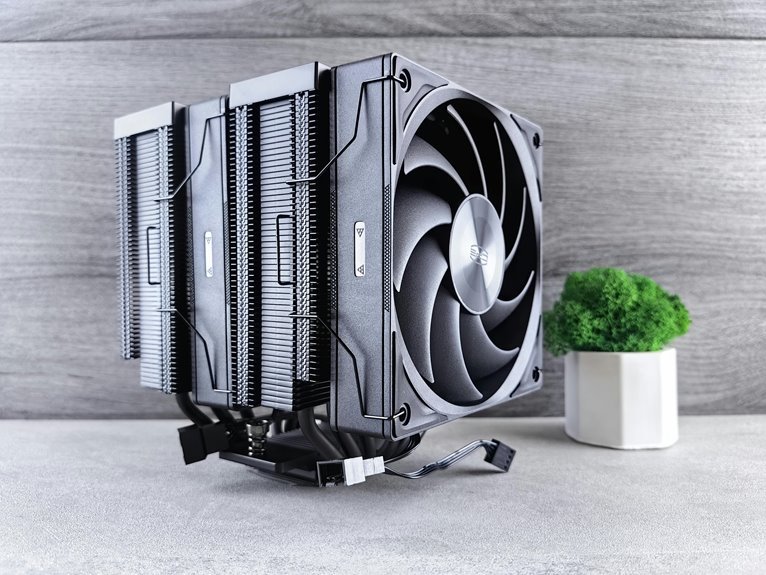
Once those temperature spikes and clock drops line up, the next step is to cool the card so it can hold its speed under load. Start with dust. Clean the heatsink, fans, and filters so air can move freely again. Then improve case ventilation by adding intake and exhaust fans that create a clear front-to-back path.
Next, check fan curves. A more aggressive curve can stop heat from building before throttling starts. Should your room runs warm, lower ambient temperature too, because your GPU can only cool below what surrounds it.
Reseat the card should airflow be blocked, and manage cables so your system can breathe. In tighter builds or hot-running rigs, better thermal paste or liquid cooling can help. You’re not stuck with throttling. Your setup can run like it belongs there.
Are Your GPU Drivers Causing Slowdowns?
While your GPU might look like the problem, bad driver behavior often causes the slowdown long before the card itself runs out of strength. If your frame rate suddenly dips after an update, you could be handling driver conflicts or shader cache issues instead of weak hardware. That can feel frustrating, especially when your setup used to run smoothly.
- You launch a game, and stutter hits right away.
- You update drivers, hoping for relief, then things get worse.
- You feel stuck because nothing looks broken.
- You want your system to feel reliable again.
Start with a clean driver reinstall using DDU. Then clear the shader cache so your GPU rebuilds fresh instructions. After that, check your control panel settings and switch from power-saving defaults to performance-focused options that fit your gaming goals.
Are Background Apps Using Your GPU?
Why does your GPU usage swing up and down even when your game should keep it busy? Often, another app quietly joins the party. Browsers, Discord, launchers, recording tools, RGB software, and VR services can all create background app GPU usage that steals resources your game needs.
That matters because your GPU must split time between your game and those extra jobs. Then concealed task GPU conflicts can appear, and you’ll see uneven usage, stutter, or sudden frame dips.
You’re not imagining it, and you’re definitely not alone. Open Task Manager, sort through GPU, and watch what spikes during play. Close overlays, browser tabs, capture apps, and unused startup tools. Also check Windows widgets and hardware monitoring apps. Whenever you trim those quiet extras, your game usually feels steadier and more responsive.
Are Power Settings Limiting GPU Speed?
Your power settings can quietly hold your GPU back, even while the card itself is ready to work harder.
Should you’re using a balanced power plan, hitting a GPU power limit, or gaming on battery saver, your system might cut clock speeds and lower performance.
That means you can see lower frame rates and uneven GPU usage without realizing a simple setting is in the way.
Power Plan Impact
Even though your GPU is powerful, the wrong Windows power plan can quietly hold it back by slowing the CPU, limiting acceleration behavior, and delaying the steady flow of work your graphics card needs. That matters because your GPU performs best whenever the rest of your system keeps pace. In balanced vs performance plans, Balanced might favor energy efficient modes that reduce responsiveness during games.
- You deserve smooth gameplay, not random slowdowns.
- Your system should feel ready whenever your team queues up.
- Tiny delays can make powerful hardware feel left out.
- A better plan helps your whole PC work together.
Switching to High Performance or Ultimate Performance can improve frame consistency, reduce dips, and help your CPU stay alert. You’re not chasing magic here. You’re removing a quiet limit so your build finally feels like it belongs in the fight.
GPU Power Limits
Power limits can act like an invisible leash on your GPU, holding back clock speed the moment the card reaches its allowed power budget. When that happens, your card protects itself through lowering speed, even though temperatures look fine. You’re not alone once this feels frustrating. Many gamers see this after power delivery caps or PSU wattage limits block full performance.
| Sign | What it means | What you can do |
|---|---|---|
| GPU Power at 100% | Power limit throttling | Check HWiNFO |
| Lower clocks under load | Card hits TDP ceiling | Raise limit in MSI Afterburner |
| Random slowdowns | PSU can’t supply enough power | Verify PSU capacity |
Once your power supply supports it, you can safely increase the power limit a bit. That gives your GPU more room to breathe.
Battery Saver Effects
Many GPU slowdowns come from simple power settings, especially on laptops or systems set to save energy.
If your frame rate drops on battery, your system may be lowering GPU clocks to stretch runtime. That means battery saver mode and laptop power saving can quietly cap performance, even when your hardware should do more.
You’re not alone when this happens. Many gamers miss these concealed limits:
- You launch a game, then feel confused when performance suddenly sinks.
- Your GPU stays underused, and you question whether something’s broken.
- Your laptop gets cautious on battery and pulls back power.
- You switch to a high performance plan, and everything feels right again.
Plugging in your charger, disabling battery saver mode, and choosing a stronger Windows power plan often restore the speed your GPU community expects.
Is Your CPU Bottlenecking the GPU?
As your GPU usage stays low while your game still struggles, your CPU might be the part holding everything back. Your processor feeds draw calls, and whenever one main thread hits 100%, the GPU waits between frames. That gap stalls the frame rendering queue and keeps performance below what your rig should deliver.
| Sign | What it means |
|---|---|
| High CPU, low GPU | Classic CPU bottleneck |
| One core maxed | Main thread can’t keep up |
| Stutter with idle GPU | Processor delays next frame |
To move ahead with the rest of us chasing smooth gameplay, check per-core usage, not just total CPU load balancing. Lower CPU-heavy settings like crowd density, view distance, and simulation detail. You can also close background apps and cap frame rates to reduce processor pressure during intense scenes.
Is Low VRAM Causing GPU Slowdowns?
Whenever your GPU runs out of VRAM, you’ll often feel it initial through sudden stutters, texture pop-in, and sharp frame-time spikes.
That happens because your system starts shifting data in and out of slower memory instead of keeping it ready on the card.
Whenever you notice smooth performance turning choppy as you raise texture quality or resolution, you might be hitting a clear memory bottleneck.
VRAM Limits And Stuttering
Why does your game feel choppy even though your GPU should handle it? Often, your card isn’t lacking raw power. Instead, it runs into VRAM limits. As textures, shadows, and effects overflow memory, the system starts swapping data constantly. That creates VRAM allocation spikes and stalls frame delivery. You feel that as hitching, not steady low FPS. This happens faster as texture streaming limits get pushed from high settings or big open worlds.
- You expect smooth play, then sudden pauses break the mood.
- You lower settings and question whether you’re falling behind everyone else.
- You notice busy scenes trigger stutter right just as moments matter.
- You want your system to feel balanced, reliable, and ready.
Signs Of Memory Bottlenecks
Low VRAM rarely looks like a simple drop in average FPS. Instead, you feel uneven frame pacing, sudden hitching when you turn the camera, and blurry textures that pop into focus late. That happens because your card starts texture swapping behavior, moving data in and out of VRAM instead of keeping everything ready.
As pressure rises, you might also notice GPU usage bouncing around, longer load times between areas, and stutters that get worse at higher texture settings. In some games, lowering resolution barely helps, which points more to memory bandwidth limits and VRAM strain than raw shader power.
You’re not imagining it whenever gameplay feels fine in one room, then rough in the next. That pattern often means assets no longer fit cleanly, and your system is scrambling to keep up with demand.
How Dust and Airflow Affect GPU Performance
Because your GPU depends on a steady flow of cool air, dust buildup and poor airflow can quietly drag performance down even while the card itself is still strong. When fans and heatsinks clog, heat stays trapped around the chip. Then your system has to slow the GPU to stay safe, and you feel that loss in games.
- You notice frames dip when your room and case both feel stuffy.
- You hear fans work harder, yet your games still feel less smooth.
- You see dust buildup on filters, blades, and vents, and it feels frustrating.
- You fix airflow obstruction, and your whole setup feels like it can breathe again.
That’s why regular cleaning matters.
While you clear vents, tidy cables, and improve case airflow, you help your GPU stay cooler, steadier, and part of a system you can trust.
Is Overclocking Making Your GPU Unstable?
Even after you fix dust and airflow, performance can still drop if your overclock pushes the GPU past its stable range. You may see stutters, driver crashes, black screens, or sudden frame drops. That’s classic overclock instability, and you’re not alone whenever it happens.
When clocks rise too far, your GPU starts making errors under load. Then it pulls back, skips work, or crashes to protect itself. That can feel frustrating, especially when you just want your system to run like everyone else’s.
Start by lowering core and memory speeds in small steps. Next, test with games and stress tools. Should needed, adjust voltage tuning carefully, because too much or too little voltage can both cause trouble. A stable overclock should feel boring in the best way. No surprises, just smooth, reliable performance every session.
How RAM and Storage Can Slow the GPU
While your GPU gets most of the blame for frame drops, your RAM and storage often decide how smoothly it can do its job. If your system can’t move game data fast enough, your GPU waits instead of rendering. RAM bandwidth limits can slow texture streaming, asset loading, and frame delivery, especially in open-world games. Storage latency bottlenecks also trigger stutter when your drive struggles to pull files quickly.
- You feel the hitching right when the action should feel smooth.
- You load into a match late and feel behind your friends.
- You notice pop-in that breaks immersion and kills momentum.
- You ask yourself why your powerful GPU still feels held back.
That doesn’t mean you’re alone.
Plenty of players face this subtle slowdown, and grasping it helps you feel more in control and connected.
Steps to Fix GPU Performance Drops
If your GPU performance keeps dropping, the fix usually starts with finding what’s holding it back, not just changing random settings and hoping for magic. Check CPU and GPU usage initially. If CPU sits at 100% while GPU stays low, lower CPU-heavy settings. If temperatures hit 83 to 90°C, improve airflow and fan curves. If power reads maxed out, raise the limit only should your PSU can handle it.
| Problem | What you check | What you do |
|---|---|---|
| CPU bottleneck | High CPU, low GPU | Lower CPU-heavy settings |
| Heat | 83 to 90°C | Clean dust, improve airflow |
| Power limit | GPU Power 100% | Adjust limit safely |
| Driver issues | Stutters, conflicts | Use driver clean installs |
| Cache problems | Repeated shader stutter | Try shader cache resets |
Then disable Game Bar and background apps.
Signs Your GPU Is Failing, Not Just Slowing Down
Because performance drops can come from heat, drivers, or a CPU bottleneck, it’s essential to know whether the problem is something more serious and your GPU might be starting to fail. Whenever your card is failing, you’ll often notice true hardware failure symptoms, not just lower frame rates. Watch for crashes under light loads, black screens, fans spinning oddly, or artifacting display patterns like bright blocks, lines, or flickers.
- You may feel worried whenever games crash even after clean driver installs.
- You might see strange colors and know something deeper is wrong.
- You can hear new noises and feel your setup isn’t acting like itself.
- You aren’t alone whenever random freezes make you question every match.
Unlike throttling or a CPU bottleneck, these signs usually grow worse over time and happen outside games too.
Frequently Asked Questions
Can a PCIE Slot Version Reduce GPU Performance?
A PCIe slot version can reduce GPU performance when the slot provides less bandwidth than the card can use. This matters most with powerful GPUs or workloads that move large amounts of data between the card and the system. Compatibility is usually not a problem, since most graphics cards can operate in older PCIe slots, but they may run at lower speed.
Does Monitor Refresh Rate Affect Perceived GPU Slowdowns?
Yes, your monitor’s refresh rate can change how GPU slowdowns feel. Uneven frame pacing is easier to spot on high refresh displays, so stutter, frame drops, and inconsistent FPS often look more obvious. The slowdown is real, but the display can make it easier to notice.
Can a Failing Display Cable Mimic GPU Performance Issues?
Yes. A bad display cable can create flicker, black screens, visual artifacts, or unstable refresh behavior, all of which can look like GPU failure. To rule it out, test a different cable and try another display port first.
How Do Game Engine Updates Change GPU Performance Unexpectedly?
Game engine updates can shift GPU performance through changes to render passes, memory allocation behavior, and shader compilation efficiency. A new version might introduce frame time spikes, reduced GPU load, or different bottlenecks, so sudden performance changes after an update are common.
Should I Upgrade the GPU or the Whole System First?
Start with the bottleneck. If your CPU is holding back frame rates, upgrade the core system first. If your GPU is running at full load, replace the graphics card first. This helps you spend where it matters most and keeps the build balanced.