

Yes, wireless charging pads waste more power than a cable. Most pads charge at about 60 to 80 percent efficiency, while wired chargers often reach 85 to 95 percent. That extra loss usually turns into heat, especially with poor alignment or thick cases. This article shows where the power goes and how to waste less while keeping the convenience.
How Efficient Are Wireless Charging Pads?
Although wireless charging feels wonderfully simple, it isn’t as efficient as plugging in a cable because the pad has to send power through a magnetic field instead of a direct wire. That means you usually get about 70 to 80 percent efficiency, though strong chargers and careful placement can push higher. If you care about energy benchmarking, that gap matters.
In daily use, your results depend on how well your phone lines up with the pad, how thick your case is, and how much heat builds up during charging. Even small shifts can waste power. That extra heat also raises questions about battery health impact over time.
Wireless vs Wired Charging Efficiency
Now that you know wireless charging pads lose some power during transfer, it helps to compare them with wired charging side by side. If you want the most efficient option, wired charging usually wins. Wired chargers often deliver about 85 to 95 percent efficiency, while wireless models commonly land closer to 60 to 80 percent in everyday use.
That gap matters when you consider charging convenience tradeoffs. You gain a cleaner, cable-free routine with wireless charging, but you also use more electricity and create more heat. In your daily tech life, that extra heat can raise battery health concerns over time.
Wired charging usually stays cooler, charges faster, and wastes less energy. So if you care about saving power and protecting your phone, wired charging helps you feel more in control and part of a smarter, more mindful crowd.
How Wireless Charging Pads Work
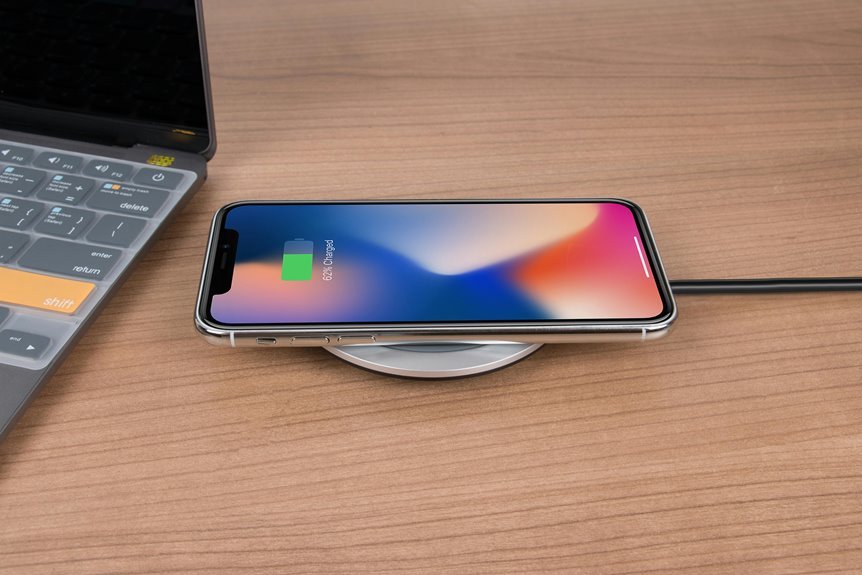
As you place your phone on a wireless charging pad, the pad sends power through a small transmitter coil that creates a changing magnetic field, and your phone’s receiver coil turns that field back into electrical current for the battery.
That process relies on electromagnetic coupling basics, so you and your device work with the same quiet team effort every time. The pad converts incoming power, drives the coil, and creates inductive power flow across a tiny gap.
| Part | Job | What you experience |
|---|---|---|
| Pad coil | Makes magnetic field | Easy placement |
| Phone coil | Captures field energy | Cable-free charging |
| Control chip | Regulates transferred power | Safe, steady charging |
As the coils communicate, your phone confirms power needs, and the pad adjusts output. It feels seamless, almost like your tech welcomes you back home.
Where Wireless Charging Power Gets Lost
You lose the most wireless charging power when your phone sits off-center, because poor coil alignment weakens the connection.
Then some energy turns into heat during power conversion inside the pad and your phone, so less of it reaches the battery.
Even small things like coins, dust, or other objects on the pad can get in the way and make charging waste more power.
Coil Alignment Losses
Although wireless charging feels simple, coil alignment is where a big share of power slips away. When you place your phone off-center, the pad’s transmitter coil and your phone’s receiver coil don’t line up well. That weakens magnetic coupling, so less energy reaches your battery. Even small shifts matter. A thick case, a raised camera bump, or a crooked placement increases the gap and makes transfer less efficient.
That’s why charger makers focus so much on coil geometry. The shape, size, and position of each coil decide how easily energy moves between them. When your phone sits centered, you get a stronger link and less wasted power. In everyday use, that means you help your charger work with your phone, not against it. You belong in that smooth, easy routine too.
Heat And Conversion Losses
Even with perfect coil alignment, wireless charging still loses power in the form of heat and repeated energy conversion. Your pad initially changes wall power, then creates a magnetic field, and your phone converts that field back into usable electricity. Each step sheds energy. Those thermal conversion losses show up as warmth in the pad, the phone, and the charging electronics.
That heat matters because your device has to manage it through limited heat dissipation pathways. Whenever parts warm up, resistance rises, and more power slips away instead of filling your battery. You can feel this during longer charging sessions, especially with faster wireless modes.
You’re not doing anything wrong. It’s simply how the system works. Understanding this helps you choose better pads, charge more mindfully, and feel part of a smarter group that values both convenience and efficiency daily.
Foreign Object Interference
As the charging system tries to send power through a clean magnetic path, small objects can get in the way and quietly waste energy. Whenever dust contamination builds up or metal debris lands on the pad, your charger has to work harder to push power across the gap. That weakens magnetic coupling, creates extra heat, and steals efficiency from every charge.
You deserve a setup that feels reliable, not frustrating.
Watch for small troublemakers like these:
- Tiny metal bits can absorb energy and warm up fast.
- Dust contamination can lift your phone slightly and reduce alignment.
- Forgotten coins, clips, or foil can trigger safety limits and slow charging.
Because of this, even a neat-looking pad could waste power.
A quick wipe and surface check help you stay connected to a smoother, more dependable charging routine every day.
Why Wireless Charging Creates Heat
Whenever your phone doesn’t sit right on the pad, the coils can’t line up well, so more of the energy slips away as heat.
You also get resistive heating because the coils and charging parts fight against electrical flow while they move power.
That’s why your charger can feel warm, and it’s your primary sign that wireless charging isn’t using every bit of energy efficiently.
Coil Misalignment Losses
Because wireless charging depends on two coils lining up just right, small shifts can waste a surprising amount of power. Whenever your phone sits off-center, flux coupling drops and less energy reaches the receiver coil. Instead, magnetic drift weakens the link between pad and phone, so charging slows and efficiency falls. You want that easy, set-it-down moment to feel seamless, but alignment really matters.
- You might feel annoyed whenever a tiny nudge steals charging time.
- You might feel left out whenever everyone else’s phone seems to charge better.
- You can feel confident being aware that a careful placement helps you belong with the smoothest setup.
Even a thick case or a few millimeters of movement can reduce performance. So whenever you center your phone carefully, you help the system transfer energy more effectively.
Resistive Heating Effects
Even though your phone is lined up well, wireless charging still creates heat because electricity meets resistance at several points in the system. As current moves through the pad coil, phone coil, and control circuits, some energy turns into warmth instead of battery power. That happens because every metal path has material resistivity, so electrons don’t glide through freely.
Then the heat can rise more at the pad and phone boundary. Tiny losses from contact surface friction, case materials, and trapped dust make the system work harder. You mightn’t see it, but your charging team does feel it.
Warmer parts mean more wasted energy, slower charging, and extra stress on your battery. That’s why good coil design, clean surfaces, and smart thermal control help you stay charged with less waste and less worry daily.
How Coil Alignment Affects Efficiency
Although wireless charging feels simple, coil alignment does most of the hard work. When your phone sits over the pad’s sweet spot, magnetic coupling stays strong and less power turns into waste heat. That’s why centered placement matters so much. Even a pad with decent alignment tolerance performs best when you line things up carefully.
- You feel confident when your phone starts charging right away.
- You avoid the annoyance of warm devices and slower top-ups.
- You get the comfort of understanding your setup works like it should.
In practical use, your pad and phone work like teammates. If the coils drift off-center, efficiency drops because the field misses part of the receiving coil. A small adjustment often restores solid charging, helping you feel in control and part of the savvy crowd.
How Distance Lowers Charging Efficiency
When your phone sits farther from the pad’s coil, the magnetic link weakens fast, and that weaker link means more power escapes as heat instead of filling your battery. Even a small lift matters because wireless charging has strict charging distance limits, and the system works best whenever both coils stay close together.
That’s why air gap sensitivity plays such a big role in your everyday charging experience. As the gap grows, your charger has to work harder to send usable energy across space. You might notice slower charging, extra warmth, or more wasted electricity. In a shared world where convenience helps you stay connected, that lost efficiency can feel frustrating. Keeping your phone close to the pad helps you get smoother, steadier charging and makes your setup feel like it’s working with you, not against you.
How Phone Cases Reduce Charging Power
That same gap problem shows up with phone cases too, because a case adds extra space between your phone’s receiver coil and the pad’s transmitter coil. Even a few millimeters can weaken magnetic coupling, so less energy reaches your battery and more turns into heat. That’s the case thickness impact in everyday use.
Some cases also interfere through protective material effects, especially when layers are dense or include metal parts, grips, or wallets. You want your setup to feel easy and dependable, not fussy.
- You set your phone down, hoping it’s charging, then feel let down when it barely moves.
- You want your device protected without feeling like you’re sacrificing convenience.
- You’re not alone as you’ve blamed the pad first.
Slim, wireless-friendly cases usually help your phone charge more smoothly and consistently each night.
How Charger Quality Affects Efficiency
As you move past case-related losses, the charger itself starts to matter just as much.
When you use a well-made pad, you get better coil alignment precision and stronger internal parts, so more power reaches your phone instead of turning into heat. When you pick a cheap charger, poor component quality can waste energy, slow charging, and leave you curious why your phone still isn’t full.
Coil Alignment Precision
Because coil alignment controls how well the pad’s magnetic field reaches your phone, charger quality has a direct effect on efficiency from the moment you set the device down. Better pads guide precision alignment and steadier coil positioning, so more power reaches your battery instead of turning into heat. That means you spend less time adjusting your phone and more time feeling like your setup just works.
- You feel relieved as your phone starts charging right away.
- You avoid that annoying worry that it’s sitting there doing almost nothing.
- You get the simple comfort of a charger that fits your daily routine.
Even small shifts matter. Whenever the coils miss each other, magnetic coupling drops fast. A well-designed pad helps you find the sweet spot easily, which keeps charging more consistent and makes your whole experience feel smoother and more dependable daily.
Component Quality Impact
While alignment still matters, the parts inside the charging pad often decide how much power actually reaches your phone. Whenever you choose a better pad, you usually get stronger coils, cleaner power control, and less wasted energy. That means your phone charges with less heat and fewer slowdowns.
Good build quality helps the pad hold steady performance day after day. Better materials reduce resistive loss, and smarter circuits waste less power during conversion. Just as significant, strong thermal design moves heat away before it builds up and steals efficiency.
You deserve a charger that feels reliable, not one that runs hot and struggles through every session. In the same way, trusted brands often tune their pads for real phones, real cases, and real daily use, so your charging routine feels smoother and more dependable in general.
How to Improve Wireless Charging Efficiency
When you want your wireless charger to waste less power, start with the basics that matter most: alignment, distance, and heat. Place your phone squarely on the pad, remove thick cases, and keep the surface clean so dust doesn’t weaken the magnetic link. Then choose a certified charger with better coils and cooling, because quality helps your device feel supported, not stressed.
- You save energy when your phone sits centered and cool.
- You protect battery health by avoiding heat and random misfires.
- You feel in control whenever small fixes make charging smoother.
Next, improve your charging habits. Use wireless mainly for overnight top ups or relaxed desk charging, where speed matters less. Unplug idle pads whenever you’re done, and you’ll waste less power while keeping your setup efficient, calm, and dependable every day.
Frequently Asked Questions
Does Wireless Charging Affect Long-Term Battery Lifespan?
Yes, wireless charging can reduce long term battery lifespan because it often creates more heat and encourages frequent top offs. Battery wear tends to increase over time, especially when the phone is misaligned on the charger, used with a thick case, or charged in a warm environment.
Are Wireless Charging Pads Safe for Medical Implants?
Use caution. Consult your physician, review your implant’s safety instructions, and follow the wireless charger manufacturer’s guidance. Wireless charging pads generate magnetic fields that may affect certain medical implants, so keeping space between the pad and the implant reduces risk.
Can Wireless Charging Interfere With Wi-Fi or Bluetooth?
Wireless charging almost never affects Wi Fi or Bluetooth because the systems operate in very different frequency ranges with little practical overlap. In unusual cases, poor shielding or low quality hardware can introduce minor interference, but this is uncommon in normal use.
Do All Phones Support the Same Wireless Charging Standard?
No, not every phone supports the same wireless charging standard. Many current phones use Qi, but some older devices and brand specific models rely on different systems or do not support wireless charging at all.
Is It Safe to Leave a Phone on the Pad Overnight?
You can usually leave your phone on the pad overnight safely if the charger is well made, the phone is positioned correctly, and the case is not too thick, because excess heat can affect both overnight safety and battery condition over time.