
You might not know that in 2026 some gaming GPUs are judged as much by efficiency and AI features as by raw frame rates.
When you are choosing between AMD RDNA 4 cards, NVIDIA Blackwell options, and older budget picks, the trade offs get more interesting than they first appear.
The right card can change how long your PC stays relevant, and a few of these models may surprise you.


More Details on Our Top Picks
GIGABYTE Radeon RX 9060 XT Gaming OC 16G Graphics Card
If you need a high-performance 16GB gaming GPU built for fast frame rates and sharp visuals, the GIGABYTE Radeon RX 9060 XT Gaming OC 16G is a strong choice for your PC. It delivers AMD RDNA 4 performance, a Radeon RX 9060 XT GPU, and 2,700 MHz boost clocks for responsive play. Its 20,000 MHz GDDR6 memory and PCIe 5.0 support help you handle demanding games smoothly. WINDFORCE cooling, Hawk Fan design, and server-grade thermal gel keep temperatures in check, and RGB lighting adds style. You also get DisplayPort and HDMI outputs, plus a 3-year warranty.
- GPU Model:Radeon RX 9060 XT
- Memory Size:16GB
- Memory Type:GDDR6
- Memory Interface:PCIe 5.0
- Cooling:WINDFORCE
- Max Resolution:7680 x 4320
- Additional Feature:PCIe 5.0 support
- Additional Feature:RGB lighting
- Additional Feature:3-year warranty
GIGABYTE Radeon RX 9060 XT Gaming OC ICE 16G Graphics Card
The GIGABYTE Radeon RX 9060 XT Gaming OC ICE 16G Graphics Card is a strong fit if you want a modern AMD GPU with up to 16 GB of VRAM, PCIe Gen 5 support, and hardware built for high-refresh gaming. It supports AMD Smart Access Memory and AI-enabled features, and pairs well with Ryzen 9000 CPUs on AM5. Its WINDFORCE cooler uses Hawk fans, copper heat pipes, and server-grade thermal gel to help keep temperatures in check. You also get DisplayPort 2.1a, HDMI 2.1b, dual BIOS, RGB control, and a reinforced two-slot build.
- GPU Model:Radeon RX 9060 XT
- Memory Size:16GB
- Memory Type:GDDR6
- Memory Interface:PCIe Gen 5
- Cooling:WINDFORCE
- Max Resolution:7680 x 4320
- Additional Feature:Dual BIOS modes
- Additional Feature:Customizable RGB colors
- Additional Feature:Alternate spinning fans
maxsun AMD Radeon RX 580 8GB Graphics Card
Maxsun’s AMD Radeon RX 580 8GB 2048SP graphics card is a solid choice if you want a budget-friendly desktop gaming GPU with strong 1080p performance and broad display support. It includes 8GB of GDDR5 memory, a 256-bit bus, and a 6000 MHz memory clock, and it is PCI-Express x16 compatible. It supports DirectX 12, Vulkan, OpenGL 4.6, and Shader Model 5.0, so you can run plenty of games smoothly. With DVI, HDMI, and DisplayPort outputs, you can connect multiple displays. Its dual-fan cooler and 3-year warranty add peace of mind.
- GPU Model:Radeon RX 580
- Memory Size:8GB
- Memory Type:GDDR5
- Memory Interface:PCIe x16
- Cooling:Dual-fan
- Max Resolution:7680 x 4320
- Additional Feature:4K video decode
- Additional Feature:3 digital output ports
- Additional Feature:3-year warranty
PNY NVIDIA GeForce RTX 5070 Epic-X ARGB Graphics Card
PNY’s GeForce RTX 5070 Epic-X ARGB OC Triple Fan is a strong pick for gamers who want high-end 1440p performance, modern AI features, and a cooler-ready design in a compact 2.4 slot card. You get NVIDIA’s Blackwell architecture, 12GB of GDDR7, 6,144 CUDA cores, and a boost clock up to 2685 MHz for smooth play. Its triple-fan cooler, ARGB lighting, and SFF-ready build fit tight cases well. You also get DLSS 4, Reflex, PCIe 5.0, HDMI 2.1b, three DisplayPort 2.1b outputs, and a 3 year warranty for peace of mind.
- GPU Model:GeForce RTX 5070
- Memory Size:12GB
- Memory Type:GDDR7
- Memory Interface:PCIe 5.0
- Cooling:Triple-fan
- Max Resolution:7680 x 4320
- Additional Feature:DLSS 4 support
- Additional Feature:6,144 CUDA cores
- Additional Feature:16-pin power cable
ASUS Prime GeForce RTX 5070 Graphics Card
If you want a powerful, SFF-ready GPU that still fits a smaller PC build, the ASUS Prime GeForce RTX 5070 is a strong choice. It uses NVIDIA Blackwell architecture, supports DLSS 4, includes 12GB of GDDR7 memory, and reaches a 2542 MHz boost clock for fast, smooth gaming. The 2.5-slot design, three Axial-tech fans, and a phase-change thermal pad help keep temperatures down under load. You also get three DisplayPort 2.1b ports and one HDMI 2.1b port, PCIe 5.0 support, and 8K-ready output. ASUS provides a 3-year warranty.
- GPU Model:GeForce RTX 5070
- Memory Size:12GB
- Memory Type:GDDR7
- Memory Interface:PCIe 5.0
- Cooling:Triple Axial-tech fans
- Max Resolution:7680 x 4320
- Additional Feature:SFF-ready design
- Additional Feature:Phase-change thermal pad
- Additional Feature:Side-panel ventilation support
MOUGOL AMD Radeon RX 580 Gaming Graphics Card
The MOUGOL AMD Radeon RX 580 is a solid pick if you want affordable 1080p gaming with dependable everyday performance. It includes 8 GB of Samsung GDDR5 memory, a 256-bit bus, and 2,048 stream processors for smooth play in Fortnite, GTA V, Apex Legends, and Valorant. Dual-fan cooling, heat pipes, and a backplate help keep temperatures in check. HDMI, DisplayPort, and DVI outputs let you run triple monitors. You also get AMD Adrenalin tools, DirectX 12 support, and hardware acceleration for Premiere Pro, Blender, and streaming.
- GPU Model:Radeon RX 580
- Memory Size:8GB
- Memory Type:GDDR5
- Memory Interface:PCIe x16 3.0
- Cooling:Dual-fan
- Max Resolution:7680 x 4320
- Additional Feature:AMD Adrenalin support
- Additional Feature:Triple-monitor support
- Additional Feature:6-pin power connector
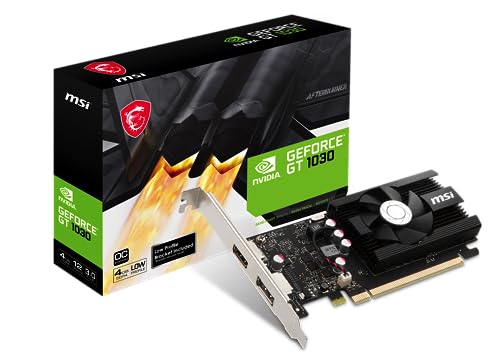
MSI GeForce GT 1030 4GB Graphics Card (GT 1030 4GD4 LP OC)
MSI’s GeForce GT 1030 4GB Low Profile OC is a smart pick if you need a compact desktop GPU for everyday gaming, media work, and light content editing without drawing much power. You get NVIDIA Pascal graphics, 4GB DDR4 memory, and a 1430 MHz boost clock for smooth basic performance. Its single fan, low profile design fits tight cases, and DisplayPort 1.4a plus HDMI 2.0b support 4K output. You can use GeForce Experience for driver alerts and one-click updates, and MSI backs it with a 3 year warranty.
- GPU Model:GeForce GT 1030
- Memory Size:4GB
- Memory Type:DDR4
- Memory Interface:PCIe x16
- Cooling:Single fan
- Max Resolution:3840 x 2160
- Additional Feature:Low-profile design
- Additional Feature:One-click driver updates
- Additional Feature:HDCP support
Factors to Consider When Choosing Gaming Graphics Cards GPUs for PC
When choosing a gaming GPU for your PC, balance performance and frame rates with memory capacity and speed so games run smoothly. Check cooling and thermal design, and verify the display outputs and resolution support you need. Finally, ensure the card fits your power supply, matches your case size, and is compatible with your overall system.
Performance And Frame Rates
Even if a GPU looks strong on paper, you will get the best gaming experience by focusing on sustained frame rates under load rather than just peak boost clocks. When you compare cards, look at how they perform in real games at 1440p and 4K, where higher clock speeds, more compute cores, and newer architectures usually deliver smoother play. You should also check whether the card can keep frame pacing steady during demanding scenes, because cooling and power limits can cause drops. Modern upscaling and frame generation features can boost apparent FPS, helping you feel higher responsiveness without rendering every frame natively. In demanding titles, a wider memory interface and faster memory speed can reduce bottlenecks, supporting more stable performance when the action gets heavy and textures load quickly.
Memory Capacity And Speed
Memory capacity and speed strongly influence how smooth games feel, especially at higher resolutions and texture settings. Treat 8 GB as the practical floor; 12 GB provides more breathing room, and 16 GB is better for demanding games and longer-term use. Faster memory increases bandwidth, which can improve texture loading, keep frame delivery steadier, and help in memory-hungry titles. Pay attention to memory type, since GDDR6 and GDDR7 usually outperform older GDDR5 or DDR4 options. A wider memory bus, such as 192-bit or 256-bit, can matter as much as speed because it moves more data each cycle. If you game at 4K or on a high-refresh display, prioritize both capacity and speed.
Cooling And Thermal Design
Cooling and thermal design can make a big difference in how well a gaming GPU performs over time. Match the cooler to the card’s heat output, because higher power models often need triple fan or 2.5 slot designs to push more air and stay cool. Look for vapor chambers, heat pipes, copper plates, and phase change thermal pads, since they help move heat from the GPU into the heatsink during long gaming sessions. Better fan layouts also matter; alternate spinning or high air pressure fans can cut turbulence and improve airflow. If the card is heavy, reinforced backplates and rigid shrouds add stability. Dual BIOS options or separate performance and silent fan profiles let you choose lower temperatures or lower noise, so evaluate cooling alongside acoustics.
Display Outputs And Resolution
Once you have settled on a card that can keep itself cool, the next thing to check is how it connects to your monitor. You need the right display ports, whether HDMI, DisplayPort, or DVI, because the card outputs must match your screen and cable setup. For modern high-refresh gaming, favor cards with newer standards like DisplayPort 2.1a or 2.1b and HDMI 2.1b, since they handle more bandwidth and advanced displays better. Also check the maximum resolution. Many cards support 3840 × 2160 for 4K, while some reach 7680 × 4320 for 8K. If you use multiple screens, confirm multi-display support and how many monitors it can drive at once. Make sure its outputs fit your gaming or productivity setup.
Power, Size, And Compatibility
Before you buy a gaming GPU, check its power draw and connector requirements, so your PSU can support it. This might mean a 16-pin plug, a dual 8-pin adapter, or no extra power connector at all on lower-power models. Measure your case and compare the card’s length, height, and slot thickness, since compact low-profile cards and triple-fan models can differ significantly. Confirm your motherboard has a PCIe x16 slot. Many modern cards use PCIe 5.0 but will still run in older slots at reduced speeds. Match HDMI and DisplayPort outputs to your monitor setup, especially for 4K, 8K, or multiple displays. Finally, leave enough room for thicker 2.4-slot or 2.5-slot coolers and ensure strong airflow.
Frequently Asked Questions
Which GPU Is Best for 4K Gaming in 2026?
For the best 4K gaming in 2026, choose the fastest flagship GPU available, most likely Nvidia’s top RTX 50 series card. It delivers the highest settings, the strongest ray tracing, and the best upscaling performance overall.
How Much VRAM Do Modern Games Need?
You will want 8 GB for 1080p, 12 GB for 1440p, and 16 GB or more for 4K in modern games. Some titles already use more, especially with high-resolution textures, ray tracing, and mods.
Are AMD or NVIDIA Cards Better for Ray Tracing?
Nvidia cards generally handle ray tracing better, delivering higher frame rates and smoother effects. AMD has improved, but in demanding titles you will typically see weaker performance unless you lower settings or enable upscaling.
What Power Supply Is Required for High-End GPUS?
You will typically need a quality 750W to 1000W power supply for high-end GPUs, depending on the GPU model and your CPU. Choose an 80 Plus Gold unit, use the correct PCIe power connectors, and leave some headroom.
Do Graphics Cards Support Multiple Monitor Setups?
Yes, you can run multiple monitors from one graphics card if it has enough display outputs. Connect each screen individually, then configure them in your operating system’s display settings for extended or mirrored viewing.