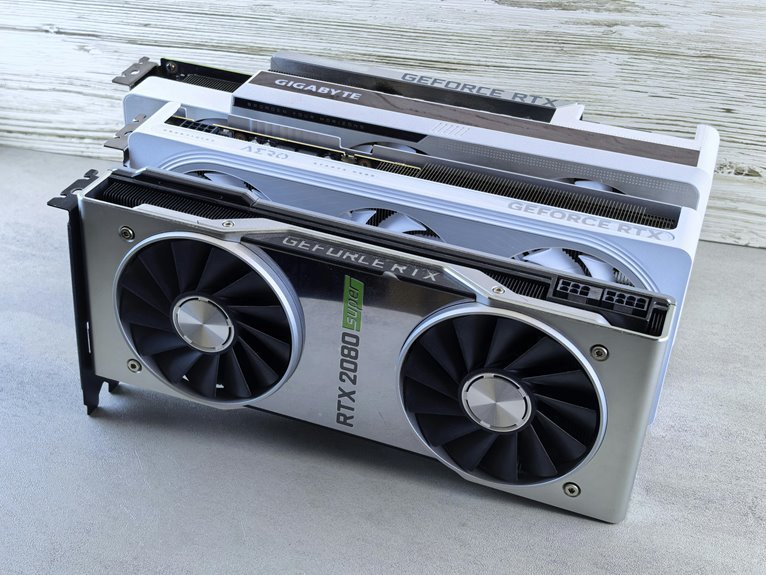


You might not know that ray tracing performance depends on more than raw shader power; memory bandwidth, VRAM, and upscaling support can change what you actually see.
If you are choosing a card for lifelike reflections and cleaner shadows, the right model can make a bigger difference than the name on the box.
Here are how these seven options compare, and which features matter most when you want detail without compromise.



More Details on Our Top Picks
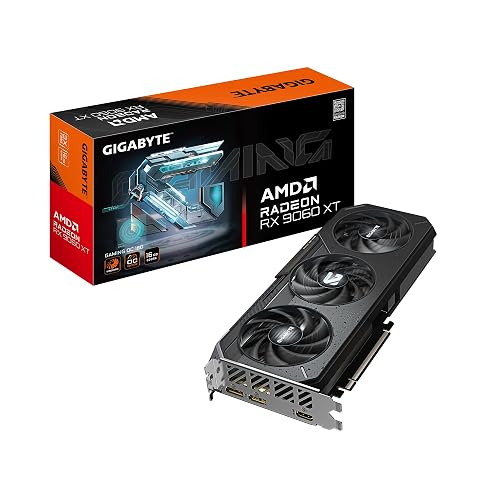
GIGABYTE Radeon RX 9060 XT Gaming OC 16G Graphics Card
If you want a graphics card that balances modern ray tracing support with strong 4K-ready performance, the GIGABYTE Radeon RX 9060 XT Gaming OC 16G is a smart pick. It features AMD RDNA 4, 16GB of GDDR6 memory, and a 2700 MHz boost clock for responsive gaming. Its PCIe 5.0 interface and 20,000 MHz memory speed help keep performance snappy. You can connect displays through HDMI or DisplayPort, and it supports up to 7680 x 4320 resolution. The WINDFORCE cooler, Hawk Fan, and thermal gel help keep temperatures in check.
- GPU Model:Radeon RX 9060 XT
- Memory:16 GB GDDR6
- PCIe 5.0:Yes
- Max Resolution:7680 x 4320
- AI/RT Features:RDNA 4 AI acceleration
- Warranty:3 years
- Additional Feature:WINDFORCE cooling system
- Additional Feature:Hawk Fan design
- Additional Feature:RGB lighting
PNY GeForce RTX 5070 Epic-X ARGB OC Graphics Card
The PNY GeForce RTX 5070 Epic-X ARGB OC Triple Fan is aimed at gamers and creators who want strong ray tracing performance without moving to a flagship-tier card. It offers 6,144 CUDA cores, fourth-generation ray tracing cores, fifth-generation Tensor cores, and Blackwell efficiency for crisp visuals and fast AI features. Its 12GB GDDR7 memory on a 192-bit bus reaches 672 GB/s, and the 2,685 MHz boost clock helps keep frame rates high. You can connect three DisplayPort 2.1b displays and one HDMI 2.1b display, and use DLSS 4, Reflex, and NVIDIA Studio support.
- GPU Model:GeForce RTX 5070
- Memory:12 GB GDDR7
- PCIe 5.0:Yes
- Max Resolution:7680 x 4320
- AI/RT Features:DLSS 4, RTX, Reflex
- Warranty:3 years
- Additional Feature:Triple-fan cooling
- Additional Feature:ARGB lighting
- Additional Feature:16-pin adapter cable
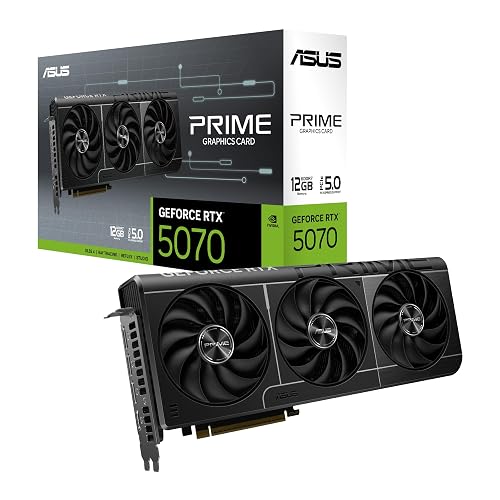
ASUS Prime GeForce RTX 5070 Graphics Card
ASUS Prime GeForce RTX 5070 brings Blackwell power and DLSS 4 to a 2.5-slot, SFF-ready design, making it a strong pick for gamers and creators who need high-end ray tracing in a smaller desktop. It includes 12 GB of GDDR7 memory, PCIe 5.0 support, and a 2542 MHz boost clock for fast, smooth rendering. Three Axial-tech fans, a phase-change GPU thermal pad, and a tuned heatsink help keep temperatures down. Dual BIOS gives you flexibility. Three DisplayPort 2.1b ports and one HDMI 2.1b port drive 8K displays. ASUS backs it with a 3 year warranty.
- GPU Model:GeForce RTX 5070
- Memory:12 GB GDDR7
- PCIe 5.0:Yes
- Max Resolution:7680 x 4320
- AI/RT Features:DLSS 4
- Warranty:3 years
- Additional Feature:Dual BIOS
- Additional Feature:SFF-ready design
- Additional Feature:Phase-change thermal pad
ASUS TUF GeForce RTX 5070 Ti OC Graphics Card
Built for gamers and creators who want serious ray tracing performance with extra headroom, the ASUS TUF GeForce RTX 5070 Ti OC Edition pairs NVIDIA’s Blackwell GPU with 16GB of fast GDDR7 memory and a rugged, cooling-focused design. You get a PCIe 5.0 x16 card with boost clocks up to 2610 MHz in OC mode, plus three Axial-tech fans, a massive fin array, and a phase-change thermal pad. Its protective coating and military-grade parts help it endure heavy loads. With HDMI 2.1b, DisplayPort 2.1a, and GPU Tweak III, you can tune, monitor, and play confidently.
- GPU Model:GeForce RTX 5070 Ti
- Memory:16 GB GDDR7
- PCIe 5.0:Yes
- Max Resolution:7680 x 4320
- AI/RT Features:DLSS 4
- Warranty:3 years
- Additional Feature:Protective PCB coating
- Additional Feature:Military-grade components
- Additional Feature:TUF graphics holder
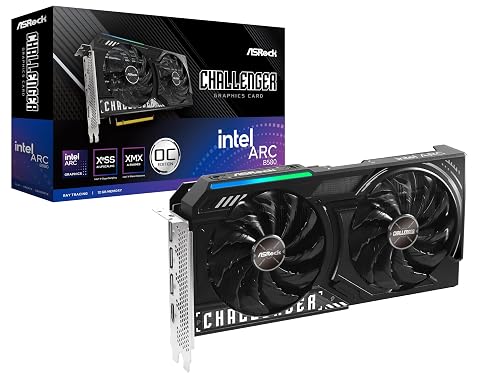
ASRock Intel Arc B580 Challenger 12GB OC Graphics Card
If you want a ray tracing-capable card geared toward 1440p gaming and AI-enhanced visuals, the ASRock Intel Arc B580 Challenger 12GB OC makes a strong case. It features Intel’s Arc B580 with 20 Xe cores, 160 XMX engines, and 12GB of GDDR6 on a 192-bit bus, so you will have room for detailed textures and XeSS 2 upscaling. Its 2,740 MHz boost clock, dual axial fans, and 0 dB mode help it stay composed. You also get three DisplayPort 2.1 ports, HDMI 2.1a, and a metal backplate for a sturdier build.
- GPU Model:Arc B580
- Memory:12 GB GDDR6
- PCIe 5.0:No, PCIe 4.0 x8
- Max Resolution:7680 x 4320
- AI/RT Features:XeSS 2, XMX
- Warranty:2 years
- Additional Feature:0dB silent cooling
- Additional Feature:Single 8-pin power
- Additional Feature:Metal backplate
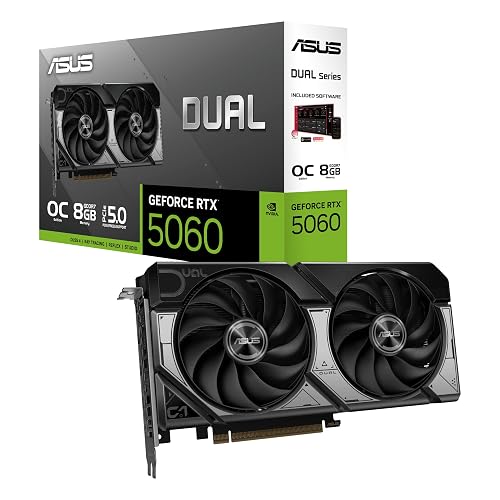
ASUS Dual GeForce RTX 5060 8GB OC Edition
The ASUS Dual GeForce RTX 5060 8GB GDDR7 OC Edition is a strong pick if you want a compact, SFF-ready ray tracing card with modern features like DLSS 4 and 623 AI TOPS. It uses NVIDIA’s Blackwell-based RTX 5060 and includes 8GB of fast GDDR7 memory. Boost clocks reach up to 2565 MHz in OC mode. ASUS pairs the card with Dual Axial-tech fans, a 2.5-slot layout, and 0dB idle behavior, so it stays quiet when you are not gaming. It also provides three DisplayPort 2.1b ports, one HDMI 2.1b port, and a three-year warranty.
- GPU Model:GeForce RTX 5060
- Memory:8 GB GDDR7
- PCIe 5.0:Yes
- Max Resolution:7680 x 4320
- AI/RT Features:DLSS 4
- Warranty:3 years
- Additional Feature:Dual Axial-tech fans
- Additional Feature:0dB idle mode
- Additional Feature:SFF-ready enthusiast card
GIGABYTE GeForce RTX 5070 AERO OC 12G Graphics Card
GIGABYTE’s GeForce RTX 5070 AERO OC 12G is a strong pick for gamers and creators who want fast ray tracing without giving up modern AI features, thanks to NVIDIA’s Blackwell architecture, DLSS 4, and enhanced RT and Tensor Cores. It includes 12GB of GDDR7 memory on a 192-bit interface, supports PCIe 5.0, and runs at a 2600 MHz GPU clock for smooth desktop performance. The WINDFORCE triple-fan cooler helps keep temperatures in check, and DisplayPort plus HDMI support resolutions up to 7680 x 4320. It is built for gaming, creative work, and everyday use.
- GPU Model:GeForce RTX 5070
- Memory:12 GB GDDR7
- PCIe 5.0:Yes
- Max Resolution:7680 x 4320
- AI/RT Features:DLSS 4
- Warranty:3 years
- Additional Feature:WINDFORCE 3-fan cooling
- Additional Feature:AERO OC design
- Additional Feature:12.75-inch length
Factors to Consider When Choosing Graphics Cards For Ray Tracing
When choosing a graphics card for ray tracing, check the ray tracing core count first, because it directly affects how well the card handles lighting and reflections. You should also prioritize robust DLSS or other upscaling support, sufficient memory capacity and bandwidth, and effective cooling with manageable power draw. Confirm the card matches your target resolution and output needs so you achieve the desired performance without creating bottlenecks.
Ray Tracing Core Count
Ray tracing core count matters because it directly affects how many ray intersection and BVH traversal tasks your GPU can handle at once, which boosts real-time ray tracing performance over shader-only approaches. When you choose a card, more RT cores usually mean lower latency and smoother frame rates in reflections, shadows, and global illumination, especially at higher resolutions or with heavier ray counts. But do not stop at the raw number, newer architectures often do more work per core so efficiency matters too. Compare RT cores alongside shader, CUDA, or compute resources and memory bandwidth, because weak supporting hardware can bottleneck the dedicated ray hardware. For hybrid rendering, pick enough RT capacity for your target ray budget, with extra headroom for dynamic lighting spikes and tougher scenes.
DLSS And Upscaling
RT core count sets the ceiling for ray tracing work, but DLSS and other upscalers often determine how well a card feels in real games. Look for cards with strong DLSS, FSR, or XeSS support, because these systems render at a lower internal resolution and rebuild the image with AI or temporal data. In practice, you can gain 30 to 60 percent more frame rates while keeping image quality close to native. That boost matters in ray traced games, where upscaling can let you enable reflections, global illumination, and shadows without crushing performance. Choose Quality mode when you want crisper edges and fewer artifacts. You will also want good engine integration, since accurate motion vectors and clean denoising help prevent ghosting and preserve fine lighting detail.
Memory Capacity And Bandwidth
Memory capacity and bandwidth matter just as much as raw ray tracing horsepower, because these workloads chew through large acceleration structures, ray payloads, textures, and history buffers. You should target 12 to 16 GB of VRAM, and even more if you want smooth 1440p or 4K ray tracing with high settings. Enough memory keeps BVH data, textures, and denoiser history from spilling over. Bandwidth also counts; 500+ GB/s can feed the GPU faster, cut bottlenecks, and raise frame rates. A wider bus, like 256 bit rather than 192 bit, paired with faster GDDR6 or GDDR7, usually delivers better effective throughput. When you enable temporal effects or longer path lengths, prioritize ample VRAM and sustained bandwidth over core count.
Cooling And Power Draw
Even though ray tracing can deliver striking visuals, it also increases GPU power draw and heat output much more than standard rasterized gaming, so you need to plan for both. Size your PSU with 20 to 30 percent headroom above the card’s peak draw. Sustained ray traced scenes can push a card close to its TDP limits and trigger power spikes. Choose a GPU with strong cooling: large heatsinks, multiple fans, and solid multi phase VRM coverage help keep junction and VRM temperatures under thermal limits, typically below about 90 degrees Celsius. Make sure your case has clear front to back airflow, because cramped airflow can raise temperatures by 10 to 20 degrees Celsius. Use quality power cables and connectors rated for the card’s current to avoid voltage drop and overheating.
Resolution And Output Support
When choosing a graphics card for ray tracing, resolution and output support matter as much as raw compute power. Higher resolutions such as 1440p, 4K, and 8K greatly increase pixel counts, so you need a GPU and driver that handle your target mode natively without crushing performance. Check the card’s ports as well: DisplayPort 2.1 and HDMI 2.1 or 2.1b provide the bandwidth required for 4K at 120 Hz or 8K at 60 Hz, along with full color depth. If you use multiple monitors, make sure the card can drive them all at high resolution. Also confirm HDR and wide-color support, since metadata and bit depth can add bandwidth demands. Future-proofing helps you stay ready for faster, sharper displays.
Frequently Asked Questions
Which Ray Tracing Card Offers the Best Performance per Dollar?
You’ll usually get the best performance per dollar from an RTX 4070 Super, since it balances strong ray tracing, efficient power use, and pricing. If you want something cheaper, consider an RTX 4060 Ti.
How Much VRAM Is Ideal for High-Resolution Ray Traced Gaming?
For high-resolution ray traced gaming, aim for at least 12 GB of VRAM, with 16 GB preferred. Sharp visuals require ample memory, and heavy scenes consume large amounts of VRAM. If you are targeting 4K, extra headroom helps prevent stutters and lets you keep settings high.
Do Ray Tracing Cards Need a Power Supply Upgrade?
Yes. You may need a power supply upgrade if the card draws more wattage than your current PSU can safely handle. Check the GPU’s recommended wattage, the required power connectors, and your system’s total power consumption first.
Can These GPUS Handle Ray Tracing With 4K Ultrawide Monitors?
Yes, you can. However, 4K ultrawide is very demanding; it has about 34% more pixels than standard 4K. You will want a high-end GPU, use DLSS or FSR, and you may need to lower ray tracing settings.
Are Current Ray Tracing Cards Future-Proof for Upcoming Games?
Not fully. You will handle upcoming games better with top-tier ray tracing cards, but you cannot guarantee future-proofing. Expect new engines to raise demands, so buy extra performance headroom and ensure DLSS support.