

If you are playing Cyberpunk 2077 at 4K with ray tracing on, a weak GPU will not cut it.
You need real headroom, fast memory, and cooling that can keep up when frame rates are pushed hard.
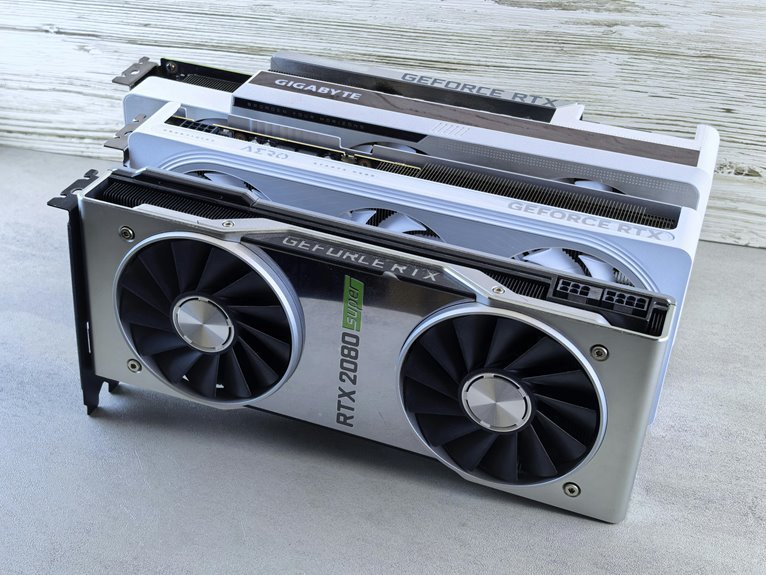
The cards in this lineup cover different strengths, from AMD and NVIDIA options to Intel’s newer entry.
One choice stands out once you compare bandwidth, upscaling, and power needs.


More Details on Our Top Picks
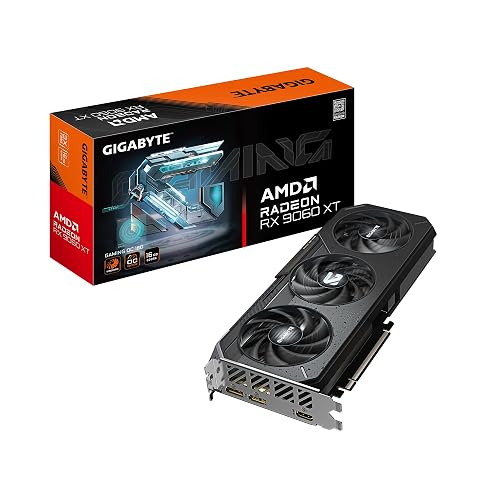
GIGABYTE Radeon RX 9060 XT Gaming OC 16G Graphics Card
If you want a 4K-capable card that balances strong gaming performance with modern features, the GIGABYTE Radeon RX 9060 XT Gaming OC 16G is worth a close look. It uses an AMD RDNA 4 GPU with 16GB of GDDR6 memory, a 2700 MHz clock, and PCIe 5.0 support. It handles 3840 x 2160 output and can scale to 8K through DisplayPort or HDMI. WINDFORCE cooling, Hawk Fan design, and server-grade thermal gel help it stay composed under load. RGB lighting adds flair, and GIGABYTE backs it with a 3-year warranty for your desktop build.
- GPU Brand:AMD Radeon
- Memory Capacity:16 GB
- Memory Type:GDDR6
- PCIe Version:PCIe 5.0
- Display Outputs:DisplayPort/HDMI
- Max Resolution:7680 x 4320
- Additional Feature:WINDFORCE cooling
- Additional Feature:Hawk Fan design
- Additional Feature:RGB lighting
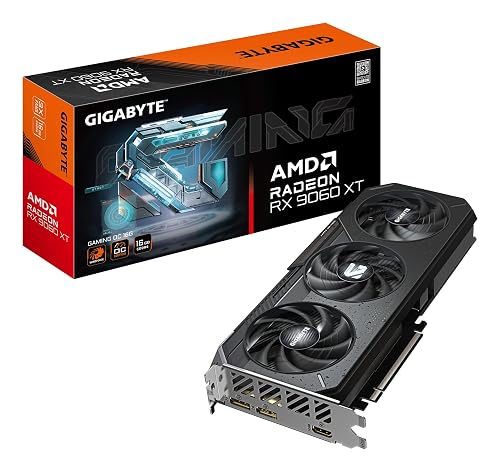
Gigabyte Radeon RX 9060 XT Gaming OC 16G Graphics Card
The Gigabyte Radeon RX 9060 XT Gaming OC 16G is a strong pick if you want a 4K-ready graphics card with 16GB of GDDR6 memory, a 3320 MHz boost clock, and WINDFORCE cooling to keep performance steady under load. You also get PCIe 5.0 support, a reinforced design, and three fans that help manage heat during long gaming sessions. With 2 DisplayPort outputs and 1 HDMI port, you can connect modern displays easily. Dual BIOS lets you choose performance or quiet operation, and RGB lighting adds style.
- GPU Brand:AMD Radeon
- Memory Capacity:16 GB
- Memory Type:GDDR6
- PCIe Version:PCIe 5.0
- Display Outputs:DisplayPort/HDMI
- Max Resolution:3840 x 2160
- Additional Feature:Dual BIOS
- Additional Feature:Reinforced structure
- Additional Feature:WINDFORCE cooling
PNY GeForce RTX 5070 Epic-X ARGB OC Graphics Card
PNY’s GeForce RTX 5070 Epic-X ARGB OC is a strong pick for gamers who want 4K-capable performance without moving up to a much pricier flagship card. It uses NVIDIA’s Blackwell GPU with 6,144 CUDA cores, 12 GB of fast GDDR7, and up to 672 GB/s of bandwidth. DLSS 4, Reflex, and fourth-gen ray tracing help deliver smoother frame rates. The triple-fan, 2.4-slot cooler and ARGB lighting keep the card cool and visually sharp. You also get DisplayPort 2.1b and HDMI 2.1b support, plus an included 16-pin to dual 8-pin cable.
- GPU Brand:NVIDIA GeForce
- Memory Capacity:12 GB
- Memory Type:GDDR7
- PCIe Version:PCIe 5.0
- Display Outputs:DisplayPort/HDMI
- Max Resolution:7680 x 4320
- Additional Feature:Triple-fan cooling
- Additional Feature:ARGB lighting
- Additional Feature:SFF-ready
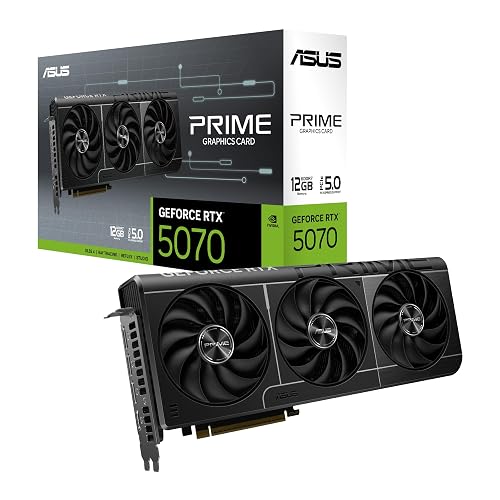
ASUS Prime GeForce RTX 5070 Graphics Card
ASUS’s Prime GeForce RTX 5070 is a sensible choice if you want a 4K-ready card that balances strong gaming features with easier system fitment. It pairs NVIDIA’s Blackwell architecture, DLSS 4, and 12 GB of GDDR7 memory with a small-form-factor-friendly 2.5 slot design. You also get PCIe 5.0 support, HDMI and DisplayPort 2.1 outputs, and dual BIOS control for flexible setup. ASUS’s Axial-tech fans use a smaller hub, longer blades, and a barrier ring to push air downward. A phase-change GPU thermal pad helps keep temperatures lower, so you should see steadier performance and improved reliability.
- GPU Brand:NVIDIA GeForce
- Memory Capacity:12 GB
- Memory Type:GDDR7
- PCIe Version:PCIe 5.0
- Display Outputs:DisplayPort/HDMI
- Max Resolution:7680 x 4320
- Additional Feature:Phase-change thermal pad
- Additional Feature:Axial-tech fans
- Additional Feature:Dual BIOS
ASUS TUF GeForce RTX 5070 Ti Graphics Card
If you want a rugged 4K gaming card that pairs strong performance with long-term durability, the ASUS TUF GeForce RTX 5070 Ti OC Edition deserves a close look. You get NVIDIA Blackwell power, 16GB of GDDR7 memory, and boost clocks up to 2610 MHz in OC mode for smooth 4K play. Its three Axial-tech fans, large fin array, and phase-change thermal pad help keep temperatures in check. You also get PCIe 5.0 support, three DisplayPort 2.1a outputs, two HDMI 2.1b ports, and a sturdy build with military-grade parts.
- GPU Brand:NVIDIA GeForce
- Memory Capacity:16 GB
- Memory Type:GDDR7
- PCIe Version:PCIe 5.0
- Display Outputs:DisplayPort/HDMI
- Max Resolution:7680 x 4320
- Additional Feature:Protective PCB coating
- Additional Feature:Military-grade components
- Additional Feature:GPU Tweak III
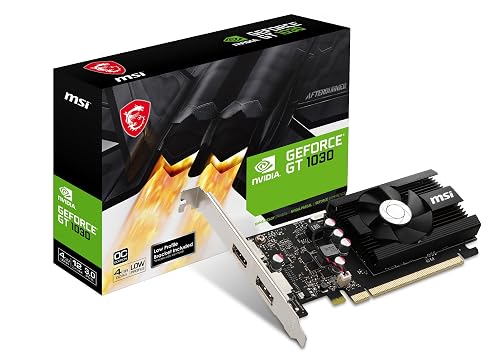
MSI GeForce GT 1030 4GB Graphics Card (GT 1030 4GD4 LP OC)
The MSI GeForce GT 1030 4GB DDR4 Low Profile OC is a compact, budget-friendly option for users who need basic 4K output, light gaming, and everyday PC acceleration rather than high-end gaming performance. It features NVIDIA Pascal graphics, 4GB of DDR4 memory, and a 64-bit memory interface, so it handles video, photos, and simple games with ease. Its low-profile single-fan design fits slim desktops, and DisplayPort plus HDMI 2.0b support 4K UHD displays. You also get DirectX 12, HDCP support, GeForce Experience, and a 3-year warranty for added peace of mind.
- GPU Brand:NVIDIA GeForce
- Memory Capacity:4 GB
- Memory Type:DDR4
- PCIe Version:PCIe x16
- Display Outputs:DisplayPort/HDMI
- Max Resolution:3840 x 2160
- Additional Feature:Low-profile design
- Additional Feature:Single-fan cooling
- Additional Feature:GeForce Experience
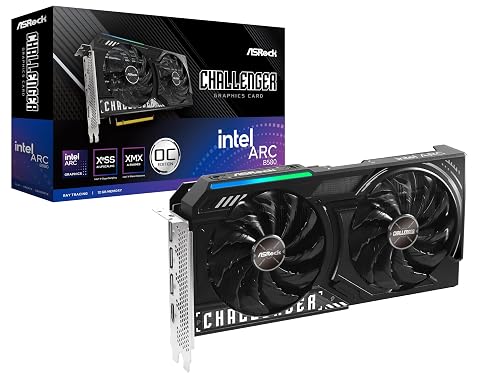
ASRock Intel Arc B580 Challenger 12GB Graphics Card
ASRock’s Intel Arc B580 Challenger 12GB OC is a smart pick if you want a 4K-ready card that favors smooth 1440p play. Its 12GB GDDR6 memory, XeSS 2 support, and 20 Xe Matrix Engines help it punch above its class in supported games and AI-assisted workloads. You also get a 2,740 MHz boost clock, PCIe 4.0 x8, and triple DisplayPort 2.1 plus HDMI 2.1a output. The dual-fan cooler, metal backplate, and 0dB mode keep things quiet, and a 650 W PSU should cover your build.
- GPU Brand:Intel Arc
- Memory Capacity:12 GB
- Memory Type:GDDR6
- PCIe Version:PCIe 4.0 x8
- Display Outputs:DisplayPort/HDMI
- Max Resolution:7680 x 4320
- Additional Feature:XeSS 2 support
- Additional Feature:0dB Silent Technology
- Additional Feature:Metal backplate
Factors to Consider When Choosing Graphics Cards GPUs for 4K
When choosing a GPU for 4K gaming, ensure you have enough VRAM to handle high resolution textures without stuttering. Also evaluate memory bandwidth, ray tracing performance, and upscaling support, since each factor influences how smooth and sharp your games look. Finally, check power supply requirements; a more powerful card often needs extra headroom to run safely.
VRAM Capacity Needs
For smooth native 4K gaming at high or ultra settings, you should aim for at least 8, 12 GB of VRAM, with 16 GB or more becoming increasingly important for modern textures, ray tracing, and future-proofing. 4K uses roughly four times the framebuffer of 1080p, and high resolution texture packs, megatextures, mods, ray tracing G buffers, and GPU side caches can quickly push memory needs into the 12 to 16 plus GB range. You will want extra headroom if you run multiple high resolution displays, stream at 4K, or juggle GPU compute workloads, because VRAM pressure can cause stuttering and paging. Check in game VRAM usage with diagnostic tools, and do not choose capacity alone; you need enough memory for 4K, but solid bandwidth also matters.
Memory Bandwidth Matters
Memory bandwidth matters just as much as VRAM for 4K gaming, because it determines how fast your GPU can move textures, frame data, and other assets to the processor. You should aim for well over 400 to 600 GB/s so your card does not become memory bound at 3840×2160 with high detail and anti aliasing. Wider buses, such as 256 bit or 384 bit, and faster memory, for example GDDR6 or GDDR7, boost throughput and help deliver smoother frame pacing. If bandwidth is too low, you will see stutter, lower averages, and more dependence on slower caches or system memory. Check the formula: memory clock (Gbps) times bus width divided by 8 equals theoretical bandwidth. Plan extra headroom for demanding features and temporal upscaling, which raise memory pressure.
Ray Tracing Performance
Ray tracing can transform 4K visuals, but it also hits your GPU hard, often cutting performance by 30% to 70% compared with rasterized rendering. Favor cards with more RT cores or equivalent hardware and stronger ray tracing throughput, because those specs directly boost frame rates at 3840×2160. High-quality effects like global illumination, reflections, and shadows demand extra headroom, so a GPU that feels fast in standard rendering may struggle here. You will also want enough memory bandwidth and shader power, since ray traced scenes can bottleneck outside the RT units themselves. For smooth play, aim for hardware that can hold at least 60 FPS in your favorite RT heavy games, whether that is native or upscaled performance, with settings tuned to match your tolerance for visual fidelity and input latency.
Upscaling Technology Support
Upscaling can be the difference between playable 4K and a frustrating frame rate, especially once ray tracing or other heavy effects push native rendering too far. You should look for modern AI upscalers that rebuild crisp 4K from 1440p or even lower, since they can preserve detail while easing GPU load. Check for hardware-accelerated temporal or AI engines, like tensor cores or XMX, because they usually beat pure software methods on image quality and cost less performance. Make sure the card works with major vendor-agnostic upscalers and game-integrated APIs, so your favorite titles can actually use them. Typical AI upscaling can raise effective frame rates by 1.5 to 3x versus native 4K. Also compare quality modes, artifact behavior, and driver update cadence for reliable results.
Power Supply Requirements
When you choose a 4K GPU, don’t overlook the PSU. High-end cards often draw 200 to 350 W on their own, and the rest of your system can add another 150 to 250 W. Add those numbers, then pick a unit with 20 to 30 percent extra headroom so you do not hit voltage sag or transient spikes. Check that it has the right PCIe plugs, 6-pin, 8-pin, or a native 12VHPWR 16-pin connector, and avoid stacking adapters that can overrun cable ratings. Look for strong rail stability and an 80 Plus Bronze, Gold, or Platinum label, since better efficiency wastes less power as heat. For long gaming or rendering sessions, choose a PSU that can sustain the load without strain.
Cooling And Size
Cooling matters as much as raw performance for 4K gaming, since high-end GPUs can dump 200 to 300+ W of heat and need multi-fan or large dual tower coolers with strong airflow to stay steady. Check the card’s slot width and length before you buy, because many 4K GPUs require 2.5 to 3.5 slots and 270 to 330 mm of clearance. Make sure your case has front or top intake and rear or top exhaust so hot air leaves fast. Keep adjacent parts from blocking the fans, and leave space around power cables and the PCIe area. Cards with vapor chambers, phase change pads, and tuned fan curves can trim temps and prevent throttling during long gaming sessions.
Output Port Compatibility
Next, check the ports on the GPU itself, because output compatibility can make or break 4K performance. You will want at least one DisplayPort 1.4 or newer, or HDMI 2.1, so you can drive 4K beyond 60 Hz without losing color depth. Older DisplayPort 1.2 and HDMI 2.0 often cap you at 4K60 or lower. If you use multiple 4K monitors, make sure the card has enough high bandwidth outputs for each display. Also verify each port’s maximum resolution and refresh rate, since some outputs support 4K120 while others do not. Check HDR, VRR, and HDCP support as well, especially for streaming and protected content. Finally, use certified DisplayPort 1.4+, 2.0, or HDMI 2.1 cables to avoid artifacts, dropouts, and handshake problems.
Frequently Asked Questions
Which GPU Offers the Best Ray Tracing for 4K Gaming?
You’d think magic isn’t real, but you’re best off with NVIDIA’s RTX 4090 for 4K ray tracing. It excels at lighting effects, maintains smooth frame rates, and still benefits from DLSS to remain playable.
How Much VRAM Is Ideal for Smooth 4K Performance?
You should aim for 16GB of VRAM for smooth 4K gaming. Twelve gigabytes can work, but it is tighter in newer titles. If you want extra headroom for high-resolution textures and future games, 20GB or more is safer.
Do These Cards Support HDMI 2.1 for 4K 120HZ Displays?
Yes. Most of these cards include HDMI 2.1, so they can drive 4K at 120 Hz without issue. Verify the exact model though, because some variants use different ports or have features that limit output.
Which Graphics Card Is Most Power Efficient at 4K?
The most power-efficient 4K option is typically NVIDIA’s RTX 4070 Ti Super. It delivers strong 4K performance at lower wattage than larger cards, so you save power without sacrificing much frame rate.
What CPU Pairs Best With a High-End 4K GPU?
You’ll pair a high-end 4K GPU best with an Intel Core i7-14700K or a Ryzen 7 7800X3D. Don’t fear having “too much CPU,” here your frame pacing stays smooth, like a race car on rails.