


Playing guitar at midnight or streaming hi-res audio on a commute used to mean compromise. Now a small amp and wireless headphones solve both problems without waking the house. This roundup covers ten options across three camps: silent-practice gear for guitarists, over-ear headphones built for studio-style listening, and pocket DAC amps that upgrade whatever you plug into them. Each pick below fits a different routine, so match the item to how you actually play and listen.
The Shortlist At A Glance

Positive Grid Spark NEO Wireless Smart Guitar Headphone Amp
LEKATO Micro Electric Guitar Headphone Amp with 5 Effects

OneOdio A70 Bluetooth Over-Ear Headphones (RG)

OneOdio A70 Bluetooth Over-Ear Headphones (Silver)

OneOdio A70 Bluetooth Over-Ear Headphones (SB)

FiiO BTR11 Bluetooth 5.3 Receiver LDAC Headphone Amp (White)

Fosi Audio K7 DAC Headphone Amp for Gaming PC PS5 Switch

HiBy W3 II Headphone Amp Bluetooth 5.2 Receiver USB DAC

FiiO BTR13 Bluetooth Headphone Amplifier with LDAC (Blue)

FiiO BTR13 Bluetooth Headphone Amplifier with LDAC (Black)
Why These Options Stand Out
This one skips the separate headphone-and-dongle dance entirely: the headphones are the rig. Custom drivers sit inside soft, noise-isolating ear cups, and a bundled wireless transmitter keeps latency low enough that fast runs don’t feel detached from your fingers. There’s also a wired 1/4-inch input built in, so electric, acoustic, and bass guitars all have a path in.
The companion Spark app adds AI-driven tone tools and a large collection of modeled gear, which turns practice into something closer to jamming with a backing band. Apartment dwellers who want amp-modeling variety without owning a single physical amp will get the most out of this setup.
Well-Handled Touches
- The included transmitter means no laggy Bluetooth guitar signal, so bends and palm mutes land when you play them.
- Noise-isolating cups keep apartment neighbors out of your practice session and your focus intact.
- App-based tone editing lets you save rigs for different songs instead of twisting knobs mid-session.
- A 1/4-inch jack covers bass and acoustic-electric players, not just standard six-string electrics.
Things To Consider
- You’re locked into Positive Grid’s ecosystem for tones, which some players find limiting over time.
- Rechargeable batteries in both cans and transmitter mean two things to top up before long sessions.
Key Specs
Who It Suits Best
Serious home players in shared living spaces who want a complete amp-and-effects rig squeezed into a pair of headphones.
Where Another Pick Suits Better
Casual strummers on a tight budget will find the LEKATO micro amp covers silent practice basics at a fraction of the commitment.
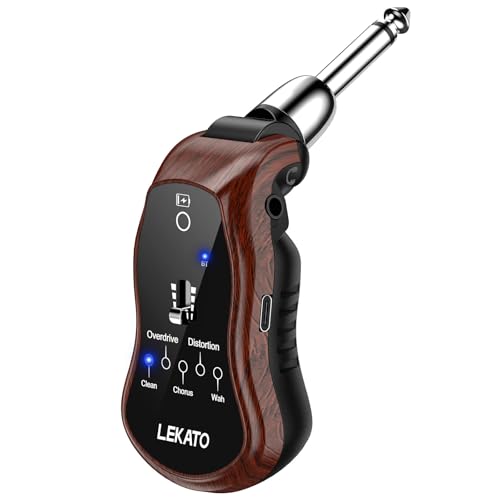
Where the Spark NEO builds a whole studio around your head, the LEKATO does the opposite: it’s a tiny plug-in box that lives on your guitar. Five onboard effects cover clean, chorus, overdrive, distortion, and wah, which honestly handles most bedroom practice material.
A volume dial sits right on the unit, so late-night level tweaks happen without touching an app. It recharges via USB, works with bass as well as electric guitar, and includes a Bluetooth receiver for playing along with tracks from your phone. First-time buyers testing whether silent practice suits them should start here before spending more.
Key Advantages
- Five distinct effects give beginners room to explore tones without buying pedals.
- Bluetooth reception lets you jam along with songs straight from a phone.
- USB charging means no hunting for coin cells before a session.
- It weighs almost nothing, so it travels inside a gig bag pocket unnoticed.
Worth Noting
- Owners commonly report the small housing makes the controls fiddly to reach mid-song.
- There’s no companion app, so tone shaping stops at what the onboard dials offer.
Right Fit For
New players and dorm-room guitarists who need cheap, grab-and-go silent practice with just enough effects to stay interested.
Not Your Match When
Players chasing realistic amp modeling and deep tone libraries will be happier with the Positive Grid Spark NEO reviewed above.
Shifting from guitar gear to pure listening, the A70 in red-gray trim is the kind of headphone that quietly handles everything. Its 40mm neodymium drivers push strong bass, and the aluminum fascia gives the build a firmer feel than the price suggests.
The party trick is dual-mode operation: up to 72 hours of wireless playback, plus a wired option using the included cables, so a dead battery never ends a session. DJs cueing tracks and home-studio listeners who bounce between phone and mixer will appreciate that flexibility more than anyone.
A Strong Showing
- 72-hour wireless runtime covers weeks of commutes between charges.
- Wired fallback means the headphones never become e-waste when the battery fades.
- Neodymium drivers deliver punchy low end that suits electronic and hip-hop material.
- Over-ear cups isolate reasonably well in moderately noisy rooms.
Trade Offs
- The aluminum accents add heft, and some wearers notice it during very long sessions.
- Earpad foam compresses over time and may need replacing after heavy daily use.
Feature Snapshot
Best Suited To
DJs, students, and commuters who want one dependable pair of over-ear headphones for music, mixing, and calls alike.
Look Elsewhere When
Listeners who prioritize featherlight comfort over battery life may prefer the lighter FiiO BTR11 pairing covered later.
Same headphone as the red-gray version above, different wardrobe. The silver finish reads more office-neutral, which matters more than it sounds when your cans sit on a desk through video calls all day.
Underneath, nothing changes: 40mm neodymium drivers, aluminum fascia panels, 72-hour wireless battery, and dual wired-or-wireless operation with the bundled cables. Anyone torn between the two colors should simply pick whichever matches their setup, since performance is identical.
Strengths Worth Knowing
- Identical 72-hour battery and driver hardware as the red-gray variant.
- The silver shell blends into professional and studio environments.
- Wired mode doubles as a backup for flights and dead-battery emergencies.
Minor Gripes
- Lighter finishes tend to show scuffs and grime faster than darker colorways.
- Clamping force runs firm at first; many owners report it relaxes after a week or two of wear.
Who Will Love This
Office workers and podcast editors who want studio-flavored sound in a colorway that doesn’t shout for attention.
A Better Fit Elsewhere
Night owls who game in dark rooms often prefer the black-toned SB variant coming next for its lower visual profile.
The third A70 colorway closes out the family. This darker finish hides wear best of the three, which is worth real money over years of daily hauling in backpacks and gig bags.
Spec-for-spec it matches its siblings: 40mm neodymium drivers behind an aluminum fascia, up to 72 hours of wireless play, and included cables for wired duty. In our view, this is the sensible default of the trio for anyone who doesn’t care about color at all.
Points In Its Favor
- Dark finish conceals scratches better than the silver or red-gray options.
- Full A70 feature set: long battery, wired backup, punchy drivers.
- Over-ear isolation helps in shared apartments and open offices.
Room For Improvement
- Like every A70, there’s no active noise cancellation, so loud transit noise still bleeds through.
- The non-detachable cable design on the wired side limits repair options down the road.
Perfect Match For
Pragmatic listeners who want maximum longevity per dollar and couldn’t care less about colorways.
Skip It When
Frequent flyers needing active noise cancellation should step up to a dedicated ANC model instead of any A70 variant.
Here’s the category’s clever middle ground: a dongle that turns any wired headphone wireless. At roughly 12.5 grams and about 5.5cm long, the white BTR11 clips to a collar or hangs from a lanyard and disappears into your day.
LDAC support is the headline. That codec streams near-hi-res quality over Bluetooth 5.3, a clear step up from basic SBC audio. Battery life reaches about 15 hours of continuous playback, and a quick hour on the charger recovers roughly 90 percent capacity. Commuters with a favorite wired pair they can’t part with are exactly who this was made for.
Good Reasons To Consider
- LDAC codec delivers noticeably cleaner wireless sound than standard Bluetooth.
- 12.5g weight means you forget it’s clipped to your shirt.
- An hour charge gets you nearly a full day of listening back.
- Two carry options, clip or lanyard, suit jackets and bags equally well.
Small Caveats
- The single 3.5mm output limits you to unbalanced headphones only.
- Tiny bodies are easy to misplace; owners suggest keeping the lanyard attached permanently.
Quick Facts
Built With In Mind
Commuters and travelers who love their existing wired earbuds but want to cut the cord without losing sound quality.
Another Choice May Suit
Listeners juggling laptops, cars, and phones across a single day will find the HiBy W3 II’s broader input options more convenient.
Everything before this point traveled in pockets; the K7 plants itself on a desk. A DAC, short for digital-to-analog converter, translates digital files into analog signal, and the K7 uses an AK4493S chip with an XMOS XU208 USB processor to do it at resolutions up to 384kHz/32-bit.
Power output hits 2100mW, plenty for demanding planar-magnetic headphones that laptop jacks can’t drive. Inputs span USB-C, optical, coaxial, Bluetooth with aptX HD and Low Latency, plus a mic input, while outputs include 4.4mm balanced, 3.5mm, and RCA. Console gamers on PS5 or Switch get a genuine upgrade path here, not just louder volume.
Standout Benefits
- 2100mW output drives hard-to-power audiophile headphones properly.
- Bluetooth Low Latency mode keeps game audio synced to on-screen action.
- Balanced 4.4mm output reduces noise for sensitive in-ear monitors.
- RCA out lets it anchor a future speaker setup too.
- Mic input supports chat headsets without a separate interface.
Points To Note
- It’s desktop-bound, so it duplicates none of the portability the BTR11 offers.
- The feature density carries a learning curve; expect an evening with the manual.
Core Details
The Right Fit
Desk-bound gamers and budding audiophiles running high-impedance headphones from a PC, PS5, or Switch setup.
Reach For A Different Pick When
Anyone whose listening happens away from a desk should look at the FiiO BTR13 instead, which packs similar codec support into a shirt pocket.
The W3 II splits the difference between the pocketable BTR11 and the desk-bound K7. Inside sits a CS43131 integrated DAC and amp chip, a part widely respected for squeezing strong conversion fidelity and amplification into minimal space.
Bluetooth 5.2 handles essentially every hi-res codec going, including LDAC, UAT, aptX HD, AAC, and SBC, so whatever your phone speaks, this receiver understands. It also plugs in over USB to phones, laptops, and PCs, and works as a car audio upgrade. One device, three roles: that versatility is the whole pitch.
Practical Pluses
- Codec coverage spans LDAC, UAT, aptX HD, AAC, and SBC, so no device gets left behind.
- USB DAC mode upgrades laptop and phone outputs instantly.
- Car-audio use breathes new life into older head units lacking modern inputs.
Honest Caveats
- Bluetooth tops out at version 5.2, a step behind the BTR11’s newer radio.
- Small portable units like this live hard in pockets; a case is worth adding early.
Whose Shelf It Belongs On
Multi-device listeners who split their day between a car, a work laptop, and a phone and want one adapter to serve all three.
Where A Sibling Pick Shines
Single-phone listeners who never touch a car or laptop will pay less for the simpler FiiO BTR11 and lose almost nothing.
The blue BTR13 is what happens when a brand refuses to cut corners on a budget dongle. Twin CS43131 DAC chips feed two outputs: a standard 3.5mm unbalanced jack and a 4.4mm balanced connection, the latter delivering cleaner separation for compatible headphones.
A three-position switch labeled PC, BT, and PHONE flips the unit between computer sound card, Bluetooth decoder, and mobile mode without menus or apps. Qualcomm’s QCC5125 chip drives the wireless side, supporting LDAC, aptX Adaptive, aptX HD, and AAC. Compared with the BTR11 earlier in this list, you’re paying for balanced output and dual DACs rather than just portability.
Notable Upsides
- Dual CS43131 DACs deliver measurably refined conversion for the size.
- 4.4mm balanced output benefits listeners with higher-end IEMs and headphones.
- The hardware mode switch changes sources instantly, no software required.
- aptX Adaptive adjusts bitrate on the fly for steadier streaming.
Potential Drawbacks
- Balanced output only pays off with 4.4mm-equipped headphones; otherwise it’s unused capability.
- More features in a small shell means more surface area to smudge and scratch in daily carry.
Feature Card
Who Should Grab It
Audiophile-curious listeners who own balanced-cable headphones and hop between a phone and a computer throughout the week.
Swap It Out When
Minimalists with a single 3.5mm earbud set will find the cheaper BTR11 covers their actual needs without the extras.
Last up, the black BTR13: identical hardware to the blue unit, dressed for people who’d rather their gear go unnoticed. Same twin CS43131 DACs, same QCC5125 Bluetooth chip, same PC/BT/PHONE switch and dual 3.5mm-plus-4.4mm outputs.
The choice between the two comes down purely to taste and, practically speaking, visibility of wear. Dark shells hide fingerprints and pocket scuffs better, which matters for something handled dozens of times a day. Everything else in the blue review above applies here unchanged.
Positive Points
- Full BTR13 feature set including balanced output and triple-mode switching.
- Black finish stays presentable through heavy daily handling.
- aptX Adaptive keeps streaming stable on congested networks.
What To Weigh
- Functionally identical to the blue model, so color is the only deciding factor.
- As with any pocket DAC, the screen-less design means settings live on connected devices.
Made For
Understated everyday carriers who want flagship-level codec support in a body nobody comments on.
Consider Something Else When
Desk-first listeners with power-hungry headphones will get far more drive from the Fosi Audio K7 reviewed earlier.
What Matters Most Before Choosing Amp Bluetooth Headphones
Match The Tool To Your Main Activity
Guitarists need latency under control above all else. A dedicated transmitter, like the one bundled with the Spark NEO, keeps playing feel immediate, while generic Bluetooth adds delay that ruins fast passages. Pure listeners can ignore latency entirely and chase codecs instead.
Codec Knowledge Pays Off
LDAC, aptX HD, and AAC determine how much detail survives the wireless trip. SBC, the default fallback, sounds noticeably flatter on good headphones. Check what your phone supports before paying for a codec you can’t use.
Power And Impedance Basics
Headphone impedance, measured in ohms, describes how much amplification a pair demands. High-impedance studio cans starve on phone jacks and need something like the Fosi K7’s 2100mW output. Sensitive earbuds need almost nothing, so a big desktop amp would be wasted money there.
Think About Where You’ll Actually Use It
A desk setup justifies a stationary unit with lots of inputs. Commuters benefit from clip-on designs under 15 grams. Guitar players practicing in apartments should weigh isolation and battery logistics before anything else, since those details shape every session.
Key Considerations Across These Picks
Traps First Timers Fall Into
The most common mistake is buying power you’ll never use, such as a 2100mW desktop amp for 16-ohm earbuds. The reverse hurts too: driving 250-ohm headphones from a bare phone jack and blaming the headphones. Also check codec compatibility on your phone first, because paying for LDAC on a device that only sends AAC buys you nothing audible.
Why Top Tier Costs More
Higher-priced units fund better DAC chips, balanced outputs, and stronger amplification stages. Those parts matter most with revealing headphones and quiet listening rooms. Casual earbud users on noisy commutes rarely hear the difference, so the upgrade only pays off once your headphones and environment can show it.
Frequently Asked Questions
Do these headphone amps work with any headphones?
Mostly yes, with one caveat. Anything with a 3.5mm plug connects directly, while 4.4mm balanced outputs require matching balanced cables on the headphone side.
Will a Bluetooth guitar amp add noticeable delay?
Generic Bluetooth usually does, which is why guitar-specific units ship dedicated transmitters. The Spark NEO’s low-latency link keeps playing feel natural where standard wireless would lag.
Is LDAC really better than regular Bluetooth audio?
Audibly, yes, on decent headphones. LDAC transfers several times more data than SBC, preserving detail that basic Bluetooth discards.
Can I use a DAC amp with a gaming console?
Models with optical or USB inputs, like the Fosi K7, connect to PS5 and Switch. Verify the specific input your console offers before ordering.
How long do rechargeable practice amps typically last per charge?
Runtime varies widely by product, from around 15 hours on small receivers to multi-day figures on large over-ear headphones. Check each listing’s stated figure against your typical session length.
Bottom Line
Your listening habits should drive this decision more than any spec sheet. Guitarists practicing after hours belong with the Spark NEO or LEKATO depending on budget, while listeners upgrading wired headphones should match a dongle or desktop amp to their devices and impedance needs. Start with the scenario you live in most days, choose accordingly, and enjoy the quiet.
