


Playing electric guitar or bass after hours usually means one thing: keeping the neighbors happy. A headphone amp plugs straight into your instrument and sends your tone to your ears instead of a speaker, so you can practice at midnight in an apartment without anyone hearing a note. The catch is that the market splits into two camps: tiny plug-in amps that shape your sound, and studio-style headphones that reveal it. This roundup covers both sides, because the best silent rig often needs one of each. Whether you’re a beginner working through your first chords or a bassist tracking late-night sessions, there’s a setup here that fits your space, your budget, and your playing style.
An Overview Of The Picks

Positive Grid Spark NEO Wireless Smart Guitar Headphone Amp
LEKATO Micro Electric Guitar & Bass Headphone Amp

Vox amPlug 3 Bass Compact Bass Headphone Amplifier

OneOdio A71D Wired Over-Ear DJ Studio Headphones

Vox amPlug 3 AC30 Headphone Guitar Amplifier

OneOdio Wired DJ Hi-Res Over-Ear Headphones (Black)

OneOdio Wired DJ Hi-Res Over-Ear Headphones (Pink)

syndesmos Over-Ear Studio Monitor Headphones

JOYO JMH-01 Studio Monitor Headphones
Flatsons F1R Mini Guitar Headphone Amp with Distortion
The Picks, Examined More Closely
This is the most complete package here, because the headphones and the wireless transmitter arrive as one system rather than two separate purchases. The custom drivers sit inside soft ear cups that isolate outside noise, so apartment dwellers can crank a virtual amp stack without leaking sound into the next room.
The included transmitter keeps latency low enough that fast lead lines don’t feel detached from your fingers, and it works with electric, acoustic, and bass guitars. A 1/4-inch wired input is built in as a backup, which matters when a battery dies mid-session. The companion app adds AI-driven tools and a large gear collection, giving you amp models and effects far beyond what any plug-in stick offers.
Notable Upsides
- Wireless freedom means no cable snagging between the couch and the practice chair
- Noise-isolating cups keep late-night sessions private in shared living spaces
- The app’s gear collection replaces a shelf full of pedals for bedroom players
- Built-in 1/4-inch jack covers wired use when wireless isn’t convenient
- Handles electric, acoustic, and bass guitars from one unit
Things To Consider
- You’ll manage charging routines for both headphones and transmitter, unlike single-cable picks such as the OneOdio A71D
- The feature depth can overwhelm someone who just wants plug-and-play simplicity
Who It Suits Best
Committed home players who want an entire amp-and-effects rig compressed into a pair of headphones will get the most from this system.
A Better Fit Elsewhere
Guitarists who prefer zero apps and instant analog tone should look at the Flatsons F1R further down this list.
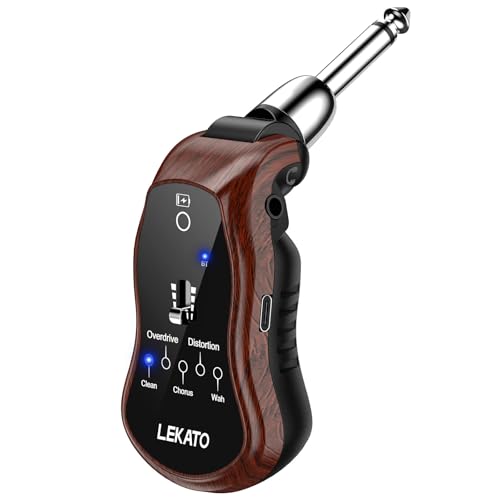
Where the Spark NEO wraps its features inside an app, the LEKATO keeps everything on the device itself. Five effects cover clean, chorus, overdrive, distortion, and wah, which is honestly enough tonal ground for a first year of playing. You plug it into the guitar’s output jack, connect headphones, and start.
A volume switch lets you dial output up or down depending on how late it is, and a built-in Bluetooth receiver lets backing tracks stream into the same headphones while you play along. The rechargeable battery removes the battery-buying chore that older plug-in amps demanded. For dorm rooms and shared apartments, that combination of silence and simplicity is hard to argue with.
Key Advantages
- Five onboard effects give beginners room to explore without extra purchases
- Bluetooth streaming means jamming along to songs through one headphone set
- Rechargeable design cuts ongoing battery costs over months of practice
- Works with both electric guitar and bass
Small Caveats
- Five fixed effects offer less tweakability than the Vox amPlug 3 AC30’s adjustable stereo processing
- Owners commonly report the small housing feels delicate, so a padded gig bag pocket is wise storage
Feature Snapshot
Made For
First-time electric players in apartments or dorms who want quiet practice without reading a manual.
Where A Sibling Pick Shines
Bassists chasing deeper, amp-like voicings will find the Vox amPlug 3 Bass better matched to their instrument.
Most plug-in amps are designed around six strings, then adapted for bass almost as an afterthought. Vox went the other direction with this one, tuning it specifically for low-end instruments that need depth rather than sparkle. The three modes, Classic, Smooth, and Funk, shift between vintage thump, rounded modern tone, and punchier articulation.
Nine built-in rhythm tracks spanning rock, funk, and blues turn solo practice into something closer to playing with a drummer, and an integrated compressor keeps notes even and consistent. Speaker emulation rounds off the harsh digital edge you sometimes hear through cheap headphone outs. In our view, this is the pick bassists should shortlist first.
Real-World Strengths
- Bass-specific tuning delivers resonant low end generic amps tend to thin out
- Nine rhythm tracks make solitary practice feel like a band rehearsal
- Integrated compressor smooths uneven fingerstyle dynamics automatically
- Three distinct modes cover classic, modern, and funk voicings
Points To Note
- The plug-in body protrudes from the jack, so careless case packing can stress the connection over time
- Guitar-only players gain nothing here compared with the AC30 version below
Right Fit For
Bass players in shared housing who want authentic low-end tone plus a practice metronome in their pocket.
Swap It Out When
Six-string players wanting richer effects should step up to the Vox amPlug 3 AC30 instead.
A headphone amp is only half of a silent rig, and these are the kind of cans worth pairing it with. The 40mm drivers deliver deep bass alongside clear mids and crisp highs, which suits mixing and monitoring work where balance matters more than boom.
The standout detail is the 90-degree swiveling ear cup, letting you pull one side off your ear to hear the room, a habit DJs and home producers rely on constantly. Padded muffs and an adjustable headband keep long sessions comfortable, and the foldable frame slips into a backpack easily. Compared with the larger-driver OneOdio Pro-10 below, this model leans slightly more toward accuracy than raw bass weight.
A Few Highlights
- Swiveling cups enable single-ear monitoring during DJ sets and mixes
- Foldable design travels well between home, studio, and gigs
- 40mm drivers present a balanced picture useful for judging your own recordings
- Soft padding holds up through multi-hour practice blocks
Honest Caveats
- Being wired, it tethers you to your amp or interface, unlike the wireless Spark NEO
- Earpad cushions collect wear with heavy daily use and may eventually need replacing
Who Will Love This
DJs, beatmakers, and guitarists who monitor critically and want one comfortable pair for both music and practice.
Consider Something Else When
Players prioritizing maximum bass impact over neutrality may prefer the OneOdio Pro-10 Black edition.
Vox built its reputation on the AC30 tube combo, the amp behind countless British invasion records, and this plug-in chases that character in headphone form. Two channels, Normal and Top Boost, take you from glassy cleans into natural-feeling overdrive as you dig in harder.
The effect set goes well beyond the LEKATO’s fixed menu: lush reverb, spacious delay, chorus, flanger, and tremolo, all processed in stereo for a wider headphone image. Nine rhythms covering rock, pop, Latin, and jazz back your practice, and an aux input accepts external audio. It’s a lot of capability packed into a body smaller than a matchbox.
What Makes Sense
- AC30-inspired voicing gives cleans and breakup real amp-like character
- Stereo effects create a spacious soundstage ordinary mono plug-ins lack
- Nine varied rhythm patterns keep practice sessions from going stale
- Aux input lets you blend in backing music from any source
Less Ideal Details
- Button-based menus mean some effect tweaking takes longer than turning a physical knob
- Plugging directly into the guitar jack puts leverage on the instrument’s output socket if stored carelessly
Quick Facts
Best Suited To
Electric guitarists who care about classic British amp character and want serious effects without pedals.
Not Your Match When
Players who want app-based amp modeling and wireless freedom belong with the Positive Grid Spark NEO.
This black edition pairs large 50mm drivers with neodymium magnets, a combination that produces genuinely powerful bass without smothering vocals or treble. Neodymium magnets, for those new to headphone specs, are simply stronger magnets that let a driver respond quickly and accurately.
For guitar practice, that low-end weight makes palm-muted riffs and drop tunings feel substantial through a headphone amp. The stretchable headband adjusts across head sizes, and thickly padded cushions isolate a fair amount of room noise passively. Owners commonly report these surviving years of daily commuting and studio use, which speaks well of the build. The honest read is that they favor fun over forensic accuracy, and plenty of players prefer exactly that.
Everyday Advantages
- 50mm drivers give distorted guitar parts satisfying weight and presence
- Padded cushions provide passive isolation helpful in noisy households
- Adjustable stretchable headband fits a wide range of users comfortably
- Widely reported durability makes them a dependable long-term companion
Trade Offs
- Bass-forward tuning is less neutral than the JOYO JMH-01 for critical mixing decisions
- Larger cups run warm during extended summer sessions
The Right Fit
Rhythm guitarists and casual listeners who want big, enjoyable sound from a wired pair they can abuse daily.
Reach For A Different Pick When
Mixing engineers needing flatter response should choose the JOYO JMH-01 listed later.
Same hardware story as the black version above: 50mm drivers with neodymium magnets delivering dynamic bass suited to DJing, mixing, and everyday listening. What changes is the finish, and that matters more than it sounds. Gear that looks good gets used more, and a colorway you actually like removes one small friction point from daily practice.
Soft padded cushions handle long sessions while providing passive noise isolation, and the adjustable, stretchable headband accommodates different head shapes. Younger players and students seem especially drawn to this variant, based on how consistently it appears in shared households. Functionally, nothing separates it from its black sibling, so the choice comes down purely to aesthetics.
Practical Pluses
- Identical 50mm driver performance to the black edition
- Distinctive pink finish stands out in shared studios and dorms
- Passive isolation helps you focus during loud household moments
- Stretchable headband suits teens and adults alike
Things That May Matter
- Light-colored finishes can show scuffs more readily than black versions
- Same bass-leaning signature, so reference-grade listeners should look elsewhere
Who Should Grab It
Students and style-conscious players who want proven OneOdio performance in a less common colorway.
Another Choice May Suit
Anyone indifferent to color saves nothing by choosing this over the cheaper-spirited syndesmos monitors below.
Starting out shouldn’t require spending much, and these prove the point. Massive 50mm dynamic drivers cover a stated 20Hz to 20kHz range, which spans the full extent of human hearing, so nothing in your mix or your guitar tone hides beyond reach.
The tuning aims for punchy bass, balanced mids, and precise treble, making them serviceable for DJ mixing, studio monitoring, and plain listening. Vocal self-monitoring during recording and tracking sessions is a highlighted strength, useful when you’re layering guitar parts over scratch vocals. Against the OneOdio Pro-10, expect a slightly leaner presentation but similar comfort ambitions. For a first pair that won’t sting financially, this is a sensible entry point.
Bright Spots
- Full-range 50mm drivers reveal detail budget headphones usually miss
- Accurate vocal monitoring helps during layered recording sessions
- Light footprint suits long practice without neck fatigue
- Low cost leaves budget left over for a plug-in amp
Where It May Fall Short
- Build materials feel lighter than pricier rivals, so gentle handling extends their life
- Fit and finish consistency can vary between units, a common note among owners
Core Details
Built With In Mind
First-time home recorders and students assembling a starter silent-practice kit on tight funds.
Look Elsewhere When
Podcasters wanting extended high-frequency detail and a longer cable should pick the JOYO JMH-01.
Among the headphones here, the JMH-01 carries the widest claimed frequency range: 15Hz to 28,000Hz, driven by 50mm large-aperture drivers with rare-earth magnets. Translation for practical purposes: deep, accurate bass, smooth mids, and highs that stay clear when cymbals or distorted guitars pile up.
The closed-back design provides passive noise isolation, handy in untreated rooms, and the 3-meter cable reaches across a typical desk or practice corner without an extension. Dual 3.5mm and 6.35mm jacks mean it connects directly to mixers, keyboards, and guitar amps without adapters. Mixing tracks, recording vocals, editing podcasts: this is the pair built for that workload, and it undercuts many studio staples doing it.
Good Reasons To Consider
- Extended frequency range exposes details narrower headphones gloss over
- Three-meter cable frees you to move around a home studio
- Dual jack sizes plug straight into pro gear and consumer devices
- Closed-back isolation keeps bleed out of vocal takes
Details To Watch
- Long fixed cable needs coiling discipline or it becomes desk spaghetti
- Monitor-flat leanings make casual music listening feel less exciting than the OneOdio Pro-10
Essential Details
Whose Shelf It Belongs On
Home recording enthusiasts, podcast editors, and guitarists who track themselves and need honest playback.
Skip It When
Listeners who want wireless convenience and amp modeling built in should choose the Positive Grid Spark NEO.
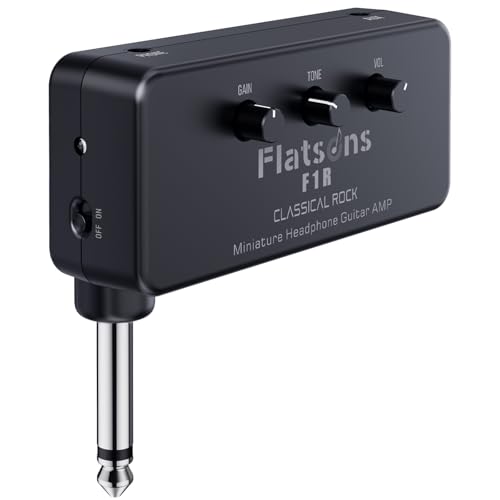
Some players don’t want menus, apps, or Bluetooth. They want to plug in and hear their guitar, honestly. The F1R answers that with a 16-bit high-precision sampling stage feeding analog amplification, plus a 1-megohm high-impedance input that preserves your pickups’ natural signal instead of loading it down.
High impedance inputs matter because passive pickups lose treble and dynamics when the input resistance is too low; the F1R sidesteps that tone loss entirely. Its distortion channel recreates classic rock voices with fullness rather than fizz, which suits players chasing seventies-style crunch. Next to the feature-heavy Vox amPlug 3 AC30, this is deliberately stripped back, and that restraint is the whole appeal.
Positive Points
- High-impedance input keeps passive pickup tone intact and dynamic
- Analog amplification path avoids the sterile edge of cheap digital circuits
- Classic-rock distortion channel sounds full at whisper volumes
- Pocket size disappears into a jacket or gig bag front pouch
Potential Sticking Points
- Single distortion voice limits genre exploration versus the LEKATO’s five effects
- No aux or Bluetooth input, so jamming along to tracks requires separate listening
Technical Reference
Who Should Grab It
Purist electric guitarists who value honest plugged-in tone over features and practice mostly alone.
Where Another Pick Suits Better
Players wanting variety and backing-track streaming will be happier with the LEKATO micro amp near the top of this list.
Choosing Between These Options Without Regret
Match The Tool To Your Instrument
Guitar and bass are not interchangeable in this category. A generic plug-in voiced for six strings tends to flatten bass fundamentals, which is why dedicated options like the Vox amPlug 3 Bass exist. Start by confirming the unit explicitly supports your instrument, then check whether its tone modes suit your genre.
Decide How Much Control You Want
There’s a real fork in the road here. App-driven systems such as the Spark NEO offer deep modeling but demand setup time and charging habits. Plug-in sticks like the Flatsons F1R trade flexibility for immediacy. Players who practice in short bursts usually prefer the latter; session-oriented musicians benefit from the former.
Don’t Underestimate The Headphones
The amp shapes your tone, but the headphones determine whether you actually hear it accurately. Closed-back designs with passive isolation, like the JOYO JMH-01, keep room noise out and prevent sound bleeding into microphones during recording. Open-back or bass-heavy consumer pairs serve casual listening better than critical work.
Think About Power And Portability
Rechargeable units eliminate the slow drip of buying coin cells, but they add a charging routine. Wired headphones never need power yet tether you to the amp. Apartment players who relocate between rooms weekly should weigh cable length and foldability as seriously as sound quality.
Key Considerations Across These Picks
Traps First Timers Fall Into
The most common mistake is buying a headphone amp voiced for the wrong instrument, then blaming the gear when bass lines sound thin. Another frequent misstep is pairing a capable amp with muddy consumer earbuds, which masks the very detail the amp was bought to deliver. Check jack compatibility too: mixers and some interfaces want a 6.35mm plug, not the standard 3.5mm.
Where The Extra Money Goes
Higher-tier units spend your money on signal quality and versatility. Better converters, higher input impedance, stereo effects processing, and app ecosystems all raise the price. Casual players practicing twenty minutes a day rarely need that ceiling; gigging musicians and home recorders hear the difference immediately and rarely go back.
Frequently Asked Questions
Do headphone amps work with acoustic guitars?
Only models with piezo-friendly inputs do, and coverage varies. The Positive Grid Spark NEO explicitly supports acoustic guitars alongside electric and bass.
Can I use regular music headphones with a guitar headphone amp?
Yes, provided the impedance and connector match. Most plug-in amps drive standard 3.5mm headphones fine, though studio pairs reveal more detail.
Will a headphone amp damage my guitar’s finish?
Quality units grip firmly without scratching, but leaving one clamped on for weeks can leave marks. Remove it after sessions and store it separately.
Are wireless headphone amps laggy?
Modern systems like the Spark NEO keep latency low enough that most players notice no delay. Cheaper Bluetooth-only solutions can introduce perceptible lag.
Do I still need an audio interface?
For silent practice, no. For recording into a computer, yes, since a headphone amp alone doesn’t digitize your signal for a DAW.
Closing Remarks
Silent practice no longer means sacrificing tone. A plug-in amp matched to your instrument, paired with headphones honest enough to show your mistakes, turns a shared apartment into a usable studio. Start with the piece that solves your biggest frustration, whether that’s noise, tone, or comfort, and build from there. Your neighbors will never know how loud you’re playing, and that’s exactly the point.
