


Quiet laptop outputs, thin phone jacks, and headphones that never quite wake up are a daily annoyance for commuters, studio musicians, and home listeners alike. A portable headphone amp fixes that by giving your cans the drive they need to actually sound like themselves. This list covers ten options spanning pocket dongles, Bluetooth receivers, desktop-style inline units, and even a practice amp for bassists. Whatever your setup looks like, there’s a match here.
An Overview Of The Picks

Donner EM1 Portable Analog Headphone Amplifier

TNP Portable 3.5mm Headphone Amplifier with RCA Input

Fosi Audio DS2 USB C Headphone Amp DAC Dongle

JOYO Vibe Cube BA-30 30W Bass Combo Amplifier

FiiO BTR17 Bluetooth 5.4 USB DAC AMP (Blue)

FIIO KA15 Portable DAC and Headphone Amplifier (Black)
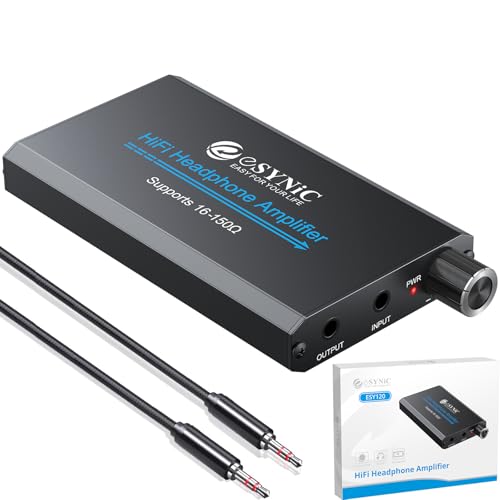
eSynic Rechargeable 16-150Ω Portable Headphone AMP

eSynic Portable Bass Boost Headphone Amplifier 16-300Ω

FiiO BTR7 Bluetooth Receiver Portable DAC (Titanium)

FiiO/Snowsky Melody Portable DAC Headphone Amplifier (Walnut)
More On The Choices That Made The List
Most pocket amps are built around a phone jack, but the Donner EM1 starts where working musicians actually live: the mixing desk. Its XLR and TRS inputs let you tap straight into a console or interface, which makes it a natural fit for in-ear monitoring during rehearsals or live sets.
The analog signal path means no conversion stages between you and the source, so what the engineer sends is what you hear. Volume sits on a dedicated control rather than buried in an app, which matters when you’re adjusting one-handed mid-song.
The Good Stuff
- XLR input plugs directly into professional mixers and interfaces without adapters
- Analog circuitry keeps monitoring honest, with no added coloration of the feed
- Rechargeable battery frees you from hunting for outlets backstage
- Simple volume knob works reliably even with gloves or sweaty hands
Honest Caveats
- No microphone support, so it’s strictly a listening device
- Lacks digital inputs, limiting its usefulness at a computer desk
Who It Suits Best
Performers and worship-team vocalists who need dependable in-ear monitoring from a mixer feed night after night.
Reach For A Different Pick When
Desk-bound listeners will get more mileage from the TNP amplifier, whose RCA input pairs naturally with AV receivers and PCs.
Where the Donner EM1 chases the stage, this little black box is happiest sitting next to a receiver or PC tower. RCA inputs accept a pre-out feed from an AV receiver, while the 3.5mm side handles phones and computers, and there’s a 6.35mm output for full-size studio headphones too.
Power comes from a 5V adapter rather than an internal cell, so it never dies mid-album. The analog volume knob gives you tactile, instant adjustment, something software sliders can’t match when you’re reaching over a cluttered desk.
The Value In It
- RCA input connects cleanly to receiver pre-outs for living-room listening
- Dual 3.5mm and 6.35mm outputs cover both earbuds and pro-style headphones
- Wall-powered design means unlimited sessions without charging breaks
- Physical knob beats fiddly buttons for quick level changes
Things To Consider
- No internal battery, so it’s tethered to an outlet wherever you place it
- Analog-only path skips any digital-to-analog conversion upgrades
Made For
Home listeners whose receiver or PC headphone output runs too quiet for demanding over-ear headphones.
Where Another Pick Suits Better
Anyone who needs true portability should look at the eSynic rechargeable unit instead, since it runs for hours untethered.
A DAC dongle combines a digital-to-analog converter with a headphone amplifier in one stick that hangs off your phone’s USB-C port. The DS2 does both jobs well, decoding up to DSD256 and PCM 32-bit/384kHz through a CS43131 chip, which is genuinely high-resolution territory for something smaller than a lighter.
Two output jacks set it apart from basic dongles: a standard 3.5mm single-ended jack and a 4.4mm balanced connection, the latter delivering more power and better channel separation for compatible cables. Commuters with hungry planar-magnetic headphones will appreciate the headroom.
Points In Its Favor
- 4.4mm balanced output drives demanding headphones with extra authority
- Hi-res decoding up to DSD256 extracts detail most phone jacks flatten out
- USB-C plug-and-play works across recent iPhones, iPads, and Android devices
- No battery to charge, drawing power straight from the host device
Small Caveats
- Siphons some battery life from your phone during long listening sessions
- Cable-hung design can strain the port if you pocket it carelessly
Quick Facts
Right Fit For
Phone-first listeners who want near-desktop sound quality without carrying anything bulkier than a thumb drive.
Swap It Out When
Wireless fans who hate cables will prefer the FiiO BTR17, which adds Bluetooth while keeping similar decoding chops.
This one bends the list’s format, and deliberately so. The Vibe Cube BA-30 is a 30-watt bass combo with a 4-inch speaker and a low-frequency radiator, but its headphone output turns it into a serious silent-practice rig for apartment dwellers. Plug in after midnight, keep the neighbors happy, still get real tone-shaping.
Bluetooth 5.1 streams backing tracks into the mix, and OTG recording sends your playing straight to a phone or tablet. The three-band EQ includes a dedicated MID FREQ control around the 200Hz region, letting you dial in growl versus thump rather than accepting a fixed voicing.
Notable Upsides
- Headphone practice mode keeps late-night sessions neighbor-friendly
- Bluetooth streaming lets you jam along with tracks wirelessly
- OTG direct recording captures takes without extra interfaces
- Built-in compressor smooths out uneven fingerstyle dynamics
Potential Sticking Points
- A 4-inch speaker has physical limits at band-rehearsal volume
- Bass-specific tuning makes it a poor fit for guitarists
Who Should Grab It
Bassists practicing in apartments or dorms who need one box covering practice, playback, and recording.
Another Choice May Suit
Listeners who only need amplification for music playback will find the Fosi Audio DS2 far simpler and cheaper.
The BTR17 sits at the sharp end of this list. Dual ES9069Q DAC chips handle conversion, THX AAA 78+ amplifier circuitry drives the output, and a 10-band parametric EQ lets you reshape frequency response with surgical precision. That combination is usually reserved for desktop gear.
Wireless credentials are current-generation: Bluetooth 5.4 with LDAC and aptX Lossless support means minimal quality loss from a compatible phone. Dual 3.5mm unbalanced and 4.4mm balanced jacks keep both cable camps happy, and a desktop mode boosts performance when you’re parked at a computer.
Why It Works Well
- THX AAA amp stage delivers low-noise power for sensitive and hard-to-drive cans alike
- 10-band PEQ allows deep sound customization beyond simple bass/treble tweaks
- LDAC and aptX Lossless preserve detail over wireless connections
- Dual ES9069Q chips provide the kind of separation usually heard in stationary rigs
- Desktop mode unlocks extra capability at a workstation
Trade Offs
- Premium pricing puts it above casual-listener budgets
- Feature depth rewards time spent learning the app controls
Feature Snapshot
Best Suited To
Audiophiles who refuse to compromise between wireless convenience and wired-grade fidelity.
Look Elsewhere When
Value-focused shoppers get remarkably close with the FiiO BTR7 below, at a friendlier entry point.
FiiO’s 5-series dongles have a reputation for packing real engineering into small bodies, and the KA15 continues that run. The redesign touches both internals and ergonomics, with a shape that sits comfortably in hand and controls placed where thumbs naturally land.
Compared with the pricier BTR17, you give up Bluetooth but keep the core promise: noticeably better sound than any phone jack, in a package that disappears into a jacket pocket. For daily commutes and office listening, that trade often lands exactly right.
Practical Pluses
- Compact body slips into pockets without snagging or bulk
- Reworked ergonomics make one-handed volume adjustments easy
- Consistent FiiO build quality suggests good long-term durability
- Plug-and-play simplicity suits people who don’t want app fiddling
Less Ideal Details
- No wireless option, unlike the BTR-series siblings in this lineup
- Detailed spec sheet isn’t fully published, making comparisons harder
Details At A Glance
The Right Fit
Commuters and office workers who want a set-and-forget wired upgrade they carry every day.
Consider Something Else When
Wood-finish lovers wanting character alongside sound should check the Snowsky Melody further down this list.
Impedance, measured in ohms, describes how much resistance headphones present to an amplifier; higher numbers demand more voltage. The eSynic covers 16 to 150 ohms with a two-stage gain switch, pairing low gain with sensitive earbuds and high gain with monitoring headphones that need a shove.
Numbers here are respectable for the money: distortion quoted at 0.0003% THD+N, signal-to-noise above 100dB, and a 1000mAh battery promising eight-plus hours at moderate output. In plain terms, it stays clean and quiet while lasting a workday away from a charger.
Useful Strengths
- Gain switch properly matches both IEMs and higher-impedance headphones
- Very low measured distortion keeps vocals and acoustic material honest
- All-day battery life handles long flights and shifts
- Simple 3.5mm in/out layout works with nearly any source
Room For Improvement
- Caps out at 150 ohms, leaving some studio classics underpowered
- No digital input, so source quality depends entirely on your device
Whose Shelf It Belongs On
First-time amp shoppers wanting a genuine upgrade without a steep financial commitment.
Not Your Match When
Owners of 250-ohm or 300-ohm headphones should step up to the eSynic bass model, which extends coverage to 300 ohms.
The second eSynic in this lineup doubles the impedance ceiling and adds a party trick: a bass lift of about +13.3dB centered around 50Hz. Electronic, hip-hop, and film scores benefit most, where kick drums and synth lines regain the weight cheap sources strip away.
Output spans roughly 160mW at 16 ohms down to 25mW at 300 ohms, with distortion held under 0.005%. Sensitive in-ear monitors reportedly stay hiss-free at low gain, which isn’t always true of budget amps pushing big numbers.
What It Does Well
- Deep bass enhancement adds visceral impact without muddying the midrange
- 300-ohm ceiling powers classic high-impedance studio headphones
- Low noise floor keeps sensitive earbuds background-silent
- Strong output figures give demanding drivers room to breathe
Factors To Consider
- The bass curve won’t suit classical or jazz purists seeking flatness
- Analog-only input ties sound quality to whatever feeds it
Core Details
Perfect Match For
EDM and hip-hop fans running harder-to-drive over-ear headphones from a phone or laptop.
Where A Sibling Pick Shines
Neutral-sound seekers with modest headphones will be happier with the flatter-tuned eSynic 16-150Ω model reviewed earlier.
Clip the BTR7 to a bag strap and it becomes a wireless DAC; tether it by USB to a laptop and it becomes a wired one. That dual personality explains its staying power in a market that moves fast. Bluetooth 5.1 supports LDAC, aptX Adaptive, aptX HD, aptX LL, AAC, and MQA, covering essentially every hi-res codec a streaming service might throw at it.
Decoding reaches 384kHz/32-bit PCM and DSD256, and dual outputs mean a 3.5mm single-ended jack plus a 4.4mm balanced connection for headphones that benefit from the extra channel separation. Car and home-audio duty work fine too, thanks to line-level-friendly output behavior.
Good Reasons To Consider
- Codec support is close to universal, from LDAC to aptX HD and MQA
- 4.4mm balanced output adds refinement for capable headphones
- Works wired via USB-C or fully wireless, adapting to the day’s plans
- Suits car, desk, and commute roles without reconfiguration
Worth Bearing In Mind
- Bluetooth 5.1 trails the newer 5.4 standard on the BTR17
- Rechargeable battery eventually degrades with heavy daily cycling
The Key Facts
Who Will Love This
Listeners splitting time between phone, laptop, and car audio who want one device doing all three jobs well.
Skip It When
Shoppers wanting the newest Bluetooth generation and PEQ depth should stretch for the FiiO BTR17 instead.
Everything else on this list wears metal or plastic; the Melody wears walnut. The CNC-carved, oil-finished wood housing feels warm in hand, and the curved profile with tactile buttons makes it pleasant to operate blind. It’s the rare piece of audio gear that draws compliments before anyone hears it.
Under the grain sit dual CS43131 DAC chips handling PCM 384kHz/32-bit and DSD256, Hi-Res certified, with both 4.4mm and 3.5mm outputs. A 10-band parametric EQ runs through the FiiO Control app, storing three custom presets, so tuning per headphone or genre is quick once configured.
Where It Delivers
- Hand-finished walnut body stands apart visually and tactilely
- Dual DAC engine delivers rich, detailed playback at a friendly price point
- Three savable EQ presets adapt quickly between headphones
- Cross-platform support spans Android, iOS, Mac, and Windows
A Few Limitations
- Wood finish needs gentler handling than anodized aluminum rivals
- EQ setup requires the companion app, adding a small learning step
Essential Details
Built With In Mind
Desk-based listeners who value craftsmanship and customization equally, especially Mac and Windows users.
Another Choice May Suit
Minimalists who prioritize pocketability over aesthetics will find the FIIO KA15 the more discreet travel partner.
Factors To Consider When Choosing Portable Headphone Amps
Match Power To Your Headphones
Start with impedance and sensitivity, printed on most headphone boxes. High-impedance models above 150 ohms need voltage-heavy amps like the eSynic 300-ohm unit, while sensitive earbuds risk hiss from overpowered gear. Matching the pair saves money and disappointment.
Wired, Wireless, Or Both
DAC dongles such as the Fosi DS2 draw power from your phone and skip batteries entirely. Bluetooth units like the BTR7 add freedom at the cost of charging routines. Decide honestly how often you’ll tolerate a cable dangling from your pocket.
Outputs And Ecosystem
A 4.4mm balanced jack only matters if you own balanced cables, so don’t pay for unused ports. Likewise, app-based EQ rewards tinkerers and annoys everyone else.
Where You’ll Actually Use It
Stage performers need XLR inputs; desk listeners need RCA; commuters need size. Let the environment pick the form factor first, then compare specs within it.
Key Considerations Across These Picks
Traps First Timers Fall Into
The commonest slip is buying raw wattage numbers instead of checking impedance compatibility, then wondering why a 300-ohm headphone sounds weak. Another is ignoring source quality; an amp can’t rescue a heavily compressed stream. Read the supported formats before assuming hi-res.
What Separates Premium From Basic
Higher tiers buy better DAC chips, lower noise floors, balanced outputs, and software depth like parametric EQ. Casual listeners rarely hear the difference on ordinary earbuds. Owners of revealing headphones hear it immediately, which is when the upgrade pays off.
Frequently Asked Questions
Do I really need a portable headphone amp?
Only your ears can confirm it, but persistent low volume or flat dynamics from a phone jack are strong hints. Most full-size headphones benefit noticeably.
Will an amp drain my phone battery faster?
Battery-free dongles draw power from the host device, so yes, somewhat. Self-powered units avoid this entirely at the cost of their own charging cycle.
What does a 4.4mm balanced output change?
Balanced connections separate left and right channels more thoroughly, often yielding cleaner sound and extra power. You’ll need a matching balanced cable to benefit.
Can one amp serve both earbuds and big headphones?
Gain switches make this practical, as seen on both eSynic models here. Without adjustable gain, sensitive earbuds may pick up background hiss.
How long do these devices typically last?
Solid-state electronics age slowly, and many users report years of service. Batteries in rechargeable units are the usual first component to fade.
Final Thoughts
Choosing among these ten comes down to honesty about your habits. Commuters should start with the Fosi DS2 or FIIO KA15, gamers of genre and tone will enjoy the eSynic bass model, and professionals belong with the Donner EM1. Match the tool to the routine and the upgrade will feel obvious every time you press play.
