


Mixing on laptop speakers or cheap earbuds hides problems you only hear after publishing a track or uploading a podcast episode. A dedicated pair of studio headphones under $100 fixes that without draining your gear budget. This list covers ten wired over-ear options built for recording, mixing, DJing, and podcasting at home.
A Snapshot Of The Selections

JOYO JMH-02 Studio Monitor Headphones 50mm

MAONO MH700 Wired Studio Headphone 50mm

OneOdio A71 Hi-Res Studio Headphones (Red)

OneOdio A71 Hi-Res Studio Headphones (Silver)

OneOdio A71 Hi-Res Studio Headphones (SB)

OneOdio A71D Wired Over-Ear DJ Headphones

Syndesmos Over Ear Studio Monitor Headphones

P PUPGSIS Wired DJ Over Ear Headphones
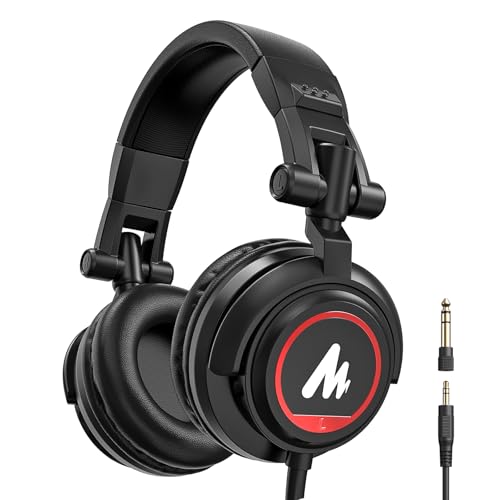
MAONO MH501 Closed Back Studio Monitor

PUPGSIS Studio Monitor Headphones (Gray)
A Closer Look At Each Pick
The JMH-02 leans into what studio monitoring actually means: big 50mm drivers tuned toward a flat response rather than boosted bass. In practice, that means you hear what your mix really contains, which matters most when you’re balancing vocals against guitars late at night.
Passive noise isolation comes from the sealed over-ear cups themselves, so there’s no battery or electronics to manage. For a bedroom producer tracking next to a computer fan, that simplicity is genuinely useful.
Strong Points
- Large 50mm drivers give mixes enough headroom to reveal quiet detail like reverb tails.
- A flat tuning keeps bass honest, so you won’t chase lows that don’t exist on other systems.
- Sealed over-ear design blocks room noise passively, useful near a loud amp or desktop PC.
- The included 3.5mm and 6.35mm adapter covers everything from laptops to guitar amps.
- Wired operation means zero charging routines before a session.
Things To Consider
- Flat tuning can feel dry to listeners used to consumer bass-heavy headphones.
- Ear pad foam compresses over time with heavy daily use, and replacements depend on the brand’s parts supply.
Key Specs
Who It Suits Best
Home producers and guitar players who want reference-grade honesty for mixing and tracking rather than casual listening color.
Where A Sibling Pick Shines
If comfort during marathon podcast edits outranks analytical accuracy, the MAONO MH700 below is the friendlier all-day wear.
Where the JOYO chases neutrality, the MH700 aims for a slightly more forgiving listen while still keeping distortion low. Its 50mm dynamic drivers cover the full audible range, so spoken word stays clear and music retains its shape during long editing blocks.
The closed-back shell suits podcasting especially well: you hear your own voice cleanly through the cans instead of room reflections. Both 3.5mm and 6.35mm jacks are covered, which means one pair works at your desk, your interface, and a keyboard rig.
Points In Its Favor
- 50mm drivers deliver balanced highs, mids, and lows with minimal distortion at typical listening levels.
- Closed-back construction helps you focus on takes in an untreated room.
- Dual jack compatibility spans computers, interfaces, amps, and keyboards.
- Over-ear fit spreads pressure around the ears, which helps during multi-hour edit sessions.
Worth Noting
- Being fully wired, cable routing matters; a snagged cord mid-take is a real annoyance.
- Some listeners may find the presentation a touch warmer than a strictly neutral reference can.
Made For
Podcasters, voiceover artists, and keyboard players who want one dependable wired can for recording and playback.
Swap It Out When
DJs who need swiveling cups for one-ear cueing will get more mileage from the OneOdio A71D later in this list.
The A71 has been around long enough to earn its reputation the slow way, through repeat owners rather than marketing. Its 40mm drivers resolve plenty of detail for mixing and DJ work, and hi-res certification signals extended high-frequency reach beyond standard CD-quality bandwidth.
This red variant is identical in performance to the silver and SB versions reviewed below, so treat this section as the family baseline. Soft padded cushions are designed specifically around long monitoring stints, which DJs notice most between sets.
What Helps Most
- 40mm drivers capture fine detail, helpful when EQing cymbals or vocal sibilance.
- Padded cushions hold up through hours of continuous wear behind the decks.
- Hi-res rated response gives extra air on top for detailed genres.
- A long track record makes replacement parts and spare cables easy to find.
- The bold red finish doubles as stage-friendly styling.
Minor Gripes
- Clamping force feels firm at first; it relaxes after a break-in period.
- Cushion covers attract lint and need occasional wiping to stay fresh.
- Colorway limits how discreet the look is in an office setting.
Right Fit For
Gigging DJs and home mix engineers who value a battle-tested design with personality.
Another Choice May Suit
Anyone wanting a quieter aesthetic with the same internals should look at the A71 Silver version directly below.
Same 40mm hi-res drivers, same cushioned over-ear build as the red A71 above, dressed in a silver finish that sits comfortably in a home studio photo without shouting. Functionally nothing changes, and that’s the point: choose by looks and availability here.
In day-to-day use the story matches its sibling. Detail retrieval is strong for the price tier, and the soft padding earns its keep during back-to-back client revisions. Owners commonly report these lasting years of regular session work, which says something about the hinge and band construction.
What Earns Its Place
- Hi-res 40mm drivers render crisp transient detail across mixing and DJ material.
- Soft ear cushions are shaped for extended monitoring comfort.
- The understated silver finish blends into professional desk environments.
Small Caveats
- Fully wired design means the fixed cable is the first thing to inspect when issues arise.
- Lighter finishes tend to show scuffs sooner than darker variants.
At A Glance
Who Will Love This
Design-conscious producers and content creators who want proven A71 performance in a neutral finish.
Reach For A Different Pick When
Traveling DJs who fold their cans into a bag should step down to the A71D’s collapsible frame further along.
This SB colorway completes the A71 trio, and it rounds out the family for anyone torn between the red’s flair and the silver’s restraint. Internals are unchanged: 40mm hi-res drivers, plush padded cushions, and a wired connection that never drops out mid-mix.
For mobile work the appeal is consistency. You can own one at home and one in a gig bag knowing both behave identically, which removes one variable from live soundchecks. Depending on your setup, having a matching backup pair costs little at this tier.
Advantages To Know
- Identical hi-res 40mm performance to the other A71 variants.
- Cushions stay comfortable through long DJ booth stretches.
- Wired reliability eliminates pairing dropouts during critical listening.
- A third color option simplifies matching a multi-headphone kit.
Honest Caveats
- Buying a third variant only makes sense if you genuinely need duplicates or a specific look.
- Like all A71s, the ear pads will eventually need cleaning or replacing with regular use.
Who Should Grab It
Working DJs building a consistent kit who want the A71 platform in a distinct colorway.
Not Your Match When
First-time buyers wanting maximum feature novelty get more from the dual-output PUPGSIS model closing this list.
The A71D takes the A71 formula and adds the two features working DJs ask for most: cups that swivel 90 degrees and a frame that folds flat. Swiveling one cup off your ear lets you cue a track against the room sound, a technique every booth regular relies on.
Sound follows the family character, with deep bass, clear mids, and crisp highs from the 40mm drivers. Compared to the fixed-cup A71 models earlier in this list, this is the version to pack for gigs rather than leave parked at the desk.
The Case For It
- 90-degree swivel cups enable true single-ear monitoring for beatmatching.
- A folding hinge shrinks the footprint for gig bags and backpacks.
- Ultra-soft ear muffs and an adjustable headband fight fatigue across long sets.
- 40mm drivers keep deep bass present without smothering vocal clarity.
Room For Improvement
- Moving hinges add potential wear points compared with fixed-frame designs.
- Bass-forward tuning is less neutral than the JOYO’s flat presentation for critical mixing.
Quick Facts
Built With In Mind
Mobile DJs and producers who split time between a bedroom setup and live booths.
Skip It When
Strictly stationary mixing engineers get better value from the flatter-tuned JOYO JMH-02 at the top of this list.
Here’s the entry ticket to serious-sounding monitoring: full-size 50mm drivers in a wired over-ear shell, priced well below the rest of this list. Getting driver hardware this size at this cost is rare, and it shows up as punchy bass alongside balanced mids and precise treble.
For a student building a first recording corner, the math is simple. You get accurate vocal self-monitoring during tracking, enough range for audiophile-style listening afterward, and a lightweight frame that doesn’t strain your neck during homework-length sessions.
Notable Upsides
- Massive 50mm dynamic drivers deliver surprising low-end authority for the price bracket.
- A wide 20Hz to 20kHz range captures both sub-bass weight and airy treble.
- Accurate vocal reproduction helps singers stay on pitch while overdubbing.
- Lightweight build keeps long study or editing sessions comfortable.
Areas To Watch
- Build materials feel lighter than pricier picks, so gentle handling extends lifespan.
- Brand support networks are thinner than established names like OneOdio or MAONO.
Whose Shelf It Belongs On
Students, first-time podcasters, and anyone testing whether dedicated monitoring improves their workflow before spending more.
Look Elsewhere When
Shoppers wanting proven durability and easy spare parts should stretch to the MAONO MH501 near the bottom of this list.
This P PUPGSIS entry plays to the bass-loving crowd. Its 50mm unit drivers push dynamic low frequencies forward while keeping mids balanced and treble precise, a signature that flatters electronic music and hip-hop production drafts alike.
The stated 20Hz to 20kHz span means you’re not losing the extremes that smaller budget drivers often skip. Compared with the Syndesmos just above, the difference comes down to emphasis: this one leans warmer and more energetic, which some ears prefer for enjoyment between work sessions.
A Strong Showing
- Large 50mm drivers generate powerful, physical bass response.
- Full-range coverage preserves clear vocals even over prominent lows.
- Immersive stereo imaging suits DJ practice and casual critical listening.
Softer Spots
- Bass-forward tuning can mask small mix errors that flatter monitors would expose.
- Availability has been inconsistent, worth verifying current status before planning around it.
- Cushion care matters; wipe them down periodically to keep the seal effective.
The Right Fit
Bedroom producers and listeners whose libraries center on bass-heavy genres and who want energy alongside utility.
Consider Something Else When
Analytical mixing is the priority, in which case the JOYO JMH-02’s flat response serves you far better.
MAONO built its name on affordable podcast gear, and the MH501 carries that DNA. The upgraded 50mm large-aperture driver delivers immersive sound with deeper, tighter bass than the brand’s earlier efforts, and clarity holds up across an extended frequency range.
The soft closed-back ear pads trim background noise enough to help you focus in an untreated room, sitting between the JOYO’s strict neutrality and the P PUPGSIS’s bass lean. As a multi-function can for tracking, editing, and general listening, it covers a lot of ground for one purchase.
Useful Touches
- Upgraded 50mm aperture driver brings fuller, more accurate bass than budget rivals.
- Soft closed-back pads reduce ambient bleed, aiding concentration during takes.
- Exceptional clarity across a wide range makes it versatile beyond one task.
- Backed by MAONO’s established creator-gear support ecosystem.
Trade Offs
- Noise reduction here is passive and modest, not a substitute for a treated room.
- Wired-only operation ties you to cable length and device placement.
Core Details
Perfect Match For
Vocalists and voiceover creators recording at home who want dependable closed-back isolation from a known brand.
A Better Fit Elsewhere
Two-person studios needing simultaneous monitoring should jump ahead to the PUPGSIS Gray model with its dual output.
The Gray PUPGSIS solves a problem most budget headphones ignore: getting two people on the same take. A built-in second headphone output lets you plug in another pair instantly, so a vocalist and engineer, or two podcast co-hosts, monitor together without splitters or adapters.
The practical details continue from there. A three-meter cable retracts automatically and resists tangling, and detachable 3.5mm and 6.35mm plugs connect to controllers, interfaces, and computers alike. No other pick on this list combines those conveniences.
Real Benefits
- Integrated second output supports instant two-person collaborative monitoring.
- Auto-retracting 3-meter cable stays tidy and resists knotting in busy rooms.
- Swappable 3.5mm and 6.35mm plugs cover DJ gear, PCs, and interfaces.
- Hi-res oriented tuning suits recording, mixing, and podcast duty.
Details To Watch
- The retractable mechanism is a moving part; rough yanking shortens its life.
- Gray finish shows dust more readily than darker shells.
Feature Snapshot
Best Suited To
Duets, co-hosted podcasts, and teaching scenarios where two people need to hear the same feed simultaneously.
Where Another Pick Suits Better
Solo engineers prioritizing pure tonal accuracy will find the JOYO JMH-02 the stronger analytical tool.
What To Weigh Before Choosing Studio Headphones Under 100 Dollars
Driver Size And Tuning
Driver diameter, measured in millimeters, describes the speaker inside each ear cup. Bigger drivers such as 50mm generally move more air, giving you firmer bass judgment, while 40mm designs often trade a little low-end for agility. Tuning matters just as much: flat response exposes mix flaws, while warmer tunings make casual listening more fun.
Open Versus Closed Backs
Closed-back cups seal sound in and room noise out, which suits recording and shared living spaces. Open designs breathe more naturally but leak audio both ways. In an apartment or untreated bedroom, closed-back models like the MAONO MH501 are usually the safer call.
Connectivity And Comfort
Confirm your sources before ordering. A 6.35mm jack fits interfaces and amps, while 3.5mm suits laptops and phones; adapters bridge the gap, and several picks here include one. Cushion material and clamping force decide whether hour-three of a session feels fine or punishing.
Matching Features To Workflow
DJs benefit from swiveling cups, podcast duos from dual outputs, and travelers from folding frames. Spend on the feature your week actually uses rather than the longest spec sheet.
Key Considerations Across These Picks
Traps First Timers Fall Into
The most common mistake is buying for bass instead of accuracy, then wondering why mixes translate poorly elsewhere. Another is ignoring connector types and discovering your interface needs a 6.35mm plug you don’t have. Skipping cushion upkeep is third; wiped pads last noticeably longer.
When Paying More Pays Off
Higher-tier models justify their cost through better driver matching, sturdier hinges, and replaceable parts. Those upgrades matter most once you log daily hours; occasional users rarely feel the difference. Spend up when headphones become a daily tool, not a weekend experiment.
Frequently Asked Questions
Are wired studio headphones still worth buying in 2026?
Yes, because wired connections add no latency and never need charging during a session. Every pick in this list is wired for exactly that reason.
Can I use studio headphones for everyday music listening?
Absolutely, though flat-tuned models sound less exciting than bass-heavy consumer pairs. Warmer options like the P PUPGSIS blur the line nicely.
Do I need an audio interface to drive these headphones?
Most 40mm and 50mm designs run happily from a laptop or phone output. An interface simply adds cleaner amplification and proper 6.35mm jacks.
How long do budget studio headphones typically last?
With normal care, expect several years of regular use. Ear pads are usually the first component to wear, and wiping them down slows that process.
What does passive noise isolation actually mean?
It refers to physical sealing from the cup and cushion design rather than powered noise cancellation. There’s no battery involved, just good fit.
Bottom Line
Every pair here proves that honest monitoring doesn’t require a four-figure budget. Match the tuning to your work: flat models like the JOYO JMH-02 for critical mixing, warmer options for enjoyment, and feature-specific picks for DJs or duos. Start with the scenario you face most often, and the right choice tends to announce itself.
